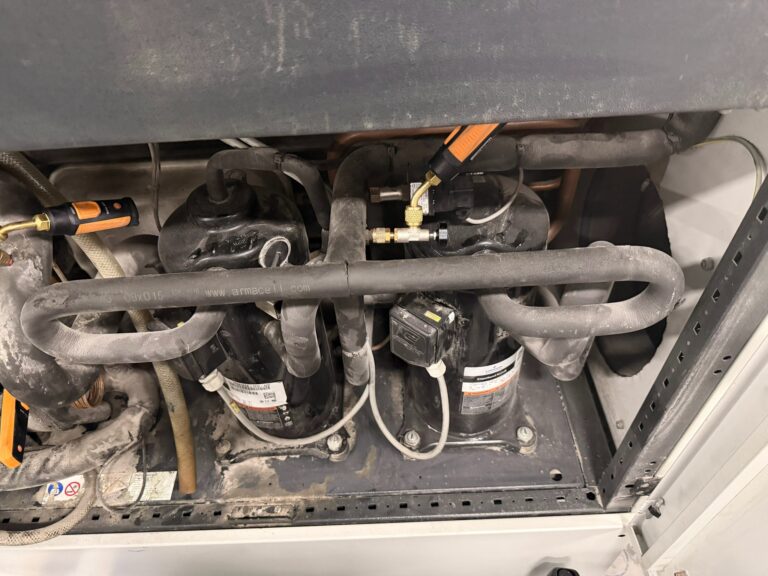
Water in Compressed Air Lines: Refrigerated Dryer Checks
Water in compressed air lines usually shows up in the least convenient places: a pneumatic valve that sticks, a spray gun that spits droplets, rust in a filter housing, a packaging machine that stops with a cylinder fault. In most plants the first suspect is the compressor, but the real cause is very often the refrigerated dryer downstream. It still runs, the green lamp is on, and yet the air it delivers is wet.
This article explains how a refrigerated compressed air dryer works, what pressure dew point means, which checks show where the water comes from, and which faults we find most often during service. It is written for maintenance teams who want to narrow the problem down before calling a technician.
How a refrigerated dryer removes water
A refrigerated dryer is a small refrigeration unit built around a heat exchanger for compressed air. Warm, saturated air from the compressor first passes an air-to-air exchanger, where it is pre-cooled by the cold outgoing air. Then it enters the evaporator, where the refrigerant cools it to a few degrees above zero. Water vapour condenses, the droplets are collected in a separator and removed by a condensate drain. On the way out, the cold dry air is reheated in the air-to-air exchanger, so the pipes do not sweat.
The refrigeration side is a compact circuit: a hermetic compressor, a condenser with a fan, an expansion device and usually a hot gas bypass valve. The bypass keeps the evaporating temperature just above freezing at low load. Without it, the evaporator would ice up when the air flow drops.
The weak points are easy to guess from this description: the condenser (dirt and heat), the refrigerant charge (leaks), the hot gas bypass (wrong setting), the separator and drain (blocked or failed), and the load (more air or warmer air than the dryer was sized for).
Pressure dew point: the number that matters
The quality of dried air is described by the pressure dew point (PDP): the temperature at which water starts to condense at the working pressure. A typical refrigerated dryer is designed for a PDP of about +3 °C, which corresponds to class 4 for humidity in ISO 8573-1. As long as the compressed air network never gets colder than that, no liquid water appears in the pipes.
Problems start when the PDP rises. At +10 °C the air is still much drier than without a dryer, but any pipe running through an unheated hall, along an outer wall or on a roof in winter will collect condensate. That is why water often appears only in one part of the plant or only in certain weather.
Many dryers have a dew point indicator on the front panel, often a simple coloured scale. It is useful for a quick look, but it measures the evaporator temperature, not the real dew point of the air. During diagnostics we measure the PDP with a calibrated dew point meter at the dryer outlet and, if needed, at the points of use.
Typical symptoms of a dryer that no longer dries
- Water or emulsion in drains of filters and pneumatic units downstream of the dryer.
- Rust or white deposits inside filter bowls and valve blocks.
- Condensate appearing after a cold night or during the first hours of a shift.
- The dew point indicator in the yellow or red range at full load.
- Outlet pipe of the dryer warm instead of slightly cool, or the opposite: frost on the evaporator side.
- The dryer drain clicks but releases only air, or never opens at all.
Where the water really comes from: a checklist
When we are called to water in the compressed air network, we go through the same order of checks. Most of them can be started by your own maintenance staff.
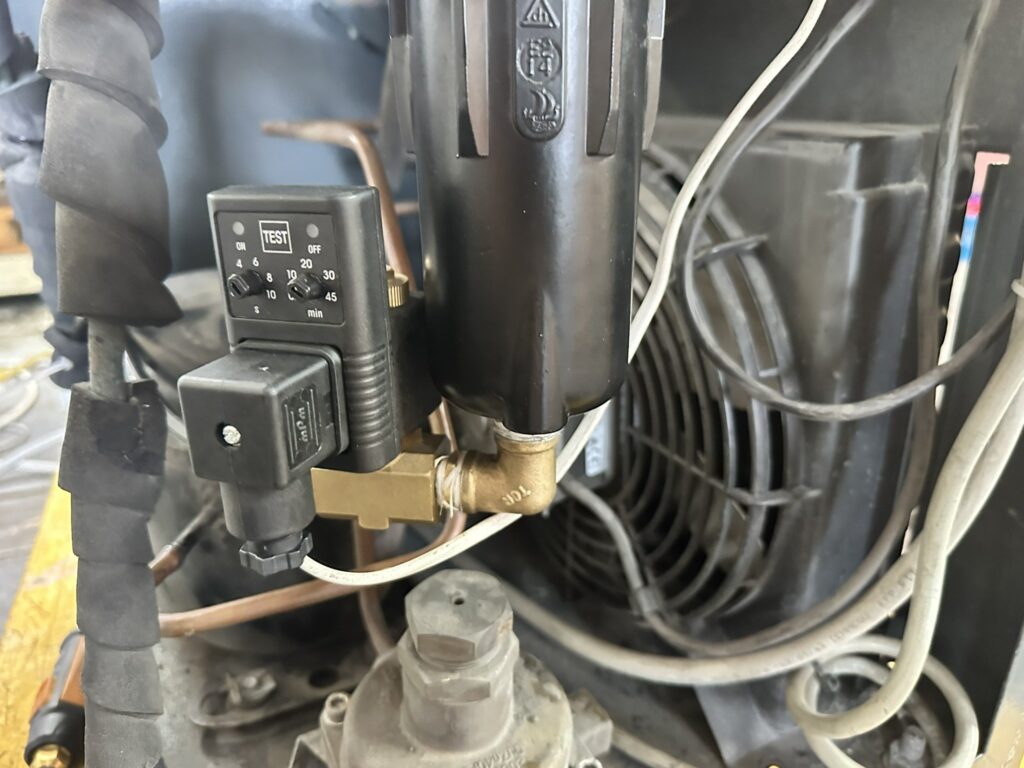
- Condensate drain. The cheapest and most frequent fault. Timed solenoid drains (like the one in the photo above) have a strainer that blocks with rust and oil sludge; the valve opens but nothing comes out. Press the test button: you should hear and see water and air leaving. Level-controlled zero loss drains fail when their sensor is dirty. If the separator is full, the dryer passes water straight into the network.
- Inlet temperature and flow. Dryers are rated at a given inlet temperature (often 35 °C) and ambient temperature. An aftercooler that does not work, a compressor room at 40 °C in summer, or an extra compressor added to the network can overload a dryer that was sized correctly years ago. Compare the actual air flow with the nameplate and apply the manufacturer’s correction factors.
- Bypass valve. Check that the dryer bypass is fully closed. A half-open bypass after maintenance work is more common than one might think.
- Condenser and ventilation. A condenser covered with dust raises the condensing pressure and reduces cooling capacity. In a compressor room the dust is often mixed with oil mist and sticks to the fins.
- Refrigerant circuit. We measure suction and discharge pressures, superheat and the compressor current. A low charge after a leak shows as a high evaporating temperature and poor drying. Small dryers often contain only a few hundred grams of refrigerant, so even a small leak changes the performance noticeably.
- Hot gas bypass setting. If the valve is set too high, the evaporator stays too warm and the dew point rises; if it is set too low or sticks closed, the evaporator ices at low load, blocks the air flow and then releases a slug of water when it thaws.
Typical faults we find in service
| Finding | Effect | Fix |
|---|---|---|
| Blocked drain strainer | Separator full, water in the network | Clean strainer, replace drain if the coil or seat is worn |
| Dirty condenser | High condensing pressure, PDP rises in summer | Clean the coil, check fan and room ventilation |
| Refrigerant leak | Gradual loss of drying, high evaporating temperature | Leak search, repair, evacuation and recharge by weight |
| Hot gas bypass misadjusted | Either wet air or icing at low load | Set the valve against measured evaporating pressure |
| Dryer undersized for current demand | Wet air at peak load only | Load analysis, additional or larger dryer |
| Compressor thermal protection trips | Dryer stops cooling while air still flows | Check supply voltage, start components, condenser |
A repair of the refrigeration circuit is regular refrigeration work: leak search, brazing, filter drier replacement, evacuation and charging. Dryers with larger charges also fall under the F-gas rules, so the leak check and the records must be kept like on any other refrigeration unit.
Prevention: what to do before the next summer
Most dryer failures are slow. A short check twice a year prevents the majority of call-outs: clean the condenser, test the drain and clean its strainer, read the dew point indicator at full load, measure the PDP once a year and compare it with the previous result. Keep the compressor room ventilated and avoid placing the dryer where it breathes the hot exhaust air of the compressor.
We service refrigerated dryers of all common brands, on site or in our workshop. More about the scope of work is on the page industrial air dryer service, and dryers can be included in a planned maintenance contract together with chillers and other refrigeration units.
Diagnostics on site start from 800 EUR net, further work is 115 EUR net per hour and travel 0.75 EUR net per km. Send us the dryer model, its nominal flow and a short description of where the water appears through the contact form or by e-mail to info@skic.com.pl.