AHU Frost Protection Alarm in Winter: Causes and Fixes
The first frosty nights bring the same call every year: the air handling unit has stopped with a frost protection alarm, the production hall or office is getting cold, and a reset helps only until the next morning. The alarm is not the fault itself. It is the controller protecting the water heating coil from bursting. Treating it as a nuisance and bridging it is the fastest way to a split coil and a flooded plant room.
This article explains how frost protection in an air handling unit (AHU) works, which faults trigger the alarm most often, how to find the cause step by step and what to check before the next winter. It is based on the cases we handle in plants, warehouses and commercial buildings.
How frost protection in an AHU works
A water heating coil can freeze within minutes when air at minus 15 °C passes through it and the water inside stops moving or cools down. To prevent that, the controller watches at least one, usually two signals:
- Frost thermostat on the air side. A capillary thermostat stretched across the coil, downstream in the air flow, typically set to about +5 to +8 °C. If any part of the capillary sees a lower temperature, the contact opens.
- Return water temperature sensor. A sensor in the return pipe of the coil. The controller keeps the return water above a set point, often around +15 to +20 °C in standby, and raises an alarm when it drops below a lower limit.
When frost protection trips, a correctly configured controller does several things at once: stops the fans, closes the outdoor air and exhaust dampers, opens the heating valve to 100 percent and starts or keeps the coil pump running. The unit then waits for a manual or automatic reset. If any part of this sequence does not work, the coil is not protected even though the alarm appears on the display.
The most common causes of the alarm
In our experience, the following causes cover almost all frost alarms in winter:
- Heating valve or actuator fault. The actuator receives a 0 to 10 V signal but the valve does not follow: a seized stem after summer, a broken coupling, a failed actuator motor or a valve that was closed by hand during works. The controller asks for heat, no heat arrives.
- Coil pump not running. In mixing circuits the pump keeps water moving through the coil. A failed pump, a tripped motor protection or a pump that the controller switches off with the fans leaves the water standing in the coil.
- Low supply water temperature. A boiler plant or district heating substation in night setback, a weather compensation curve set too low, or a primary circuit with poor flow. The valve can be fully open and still not deliver enough heat.
- Air in the coil. An air pocket blocks part of the coil. Typically after refilling the system in autumn without proper venting.
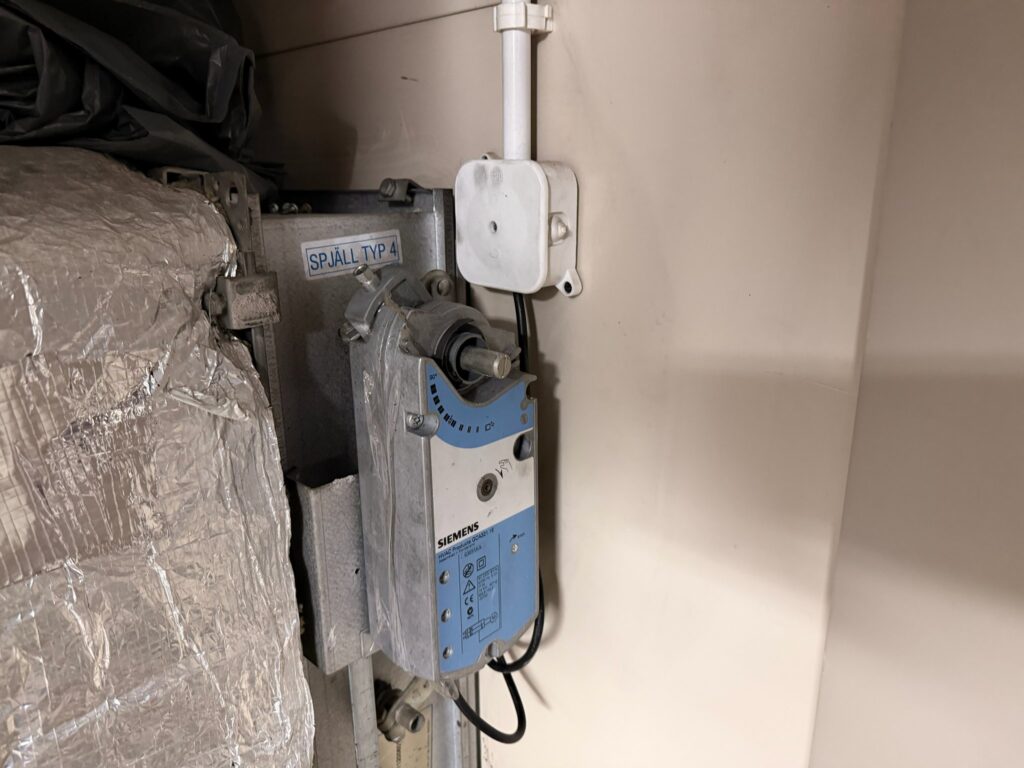
- Dampers that do not close tightly. When the unit stops, cold air keeps entering through a leaking outdoor damper or a damper whose actuator does not close fully. The coil cools down even with the fans off, and the alarm appears at night when nobody looks at the unit. The actuator in the photo above is exactly the kind of component we test.
- Air stratification. In units with a mixing section, cold outdoor air and warm return air may not mix well, so one corner of the coil gets much colder air than the average sensor shows. The capillary thermostat catches it, the supply air sensor does not.
- Sensor or setting faults. A broken capillary, a thermostat set too high, a return water sensor out of its pocket, wrong alarm limits after a controller replacement.
Step by step diagnostics on site
We work through the circuit from the coil outwards, always with measured values instead of assumptions:
- Read the alarm history and the trend of the return water temperature, supply air temperature and outdoor temperature from the controller or BMS. The time of the alarm often points to night setback or to the start of the unit in the morning.
- Force the heating valve to 100 percent and check the actuator stroke on site. Measure the supply and return pipe temperatures at the coil by contact thermometer or thermal camera.
- Check that the coil pump runs, rotates in the right direction and gives flow. Listen for air in the coil and vent it.
- Measure the supply water temperature from the heat source. Compare it with the design values of the coil.
- Close the dampers from the controller and check by hand and with a smoke test whether they seal. Test the spring return of the actuators if the unit uses them.
- Test the frost thermostat with cold spray along the capillary and check its set point. Check the position and wiring of the return water sensor.
- Check the start sequence: in winter the controller should preheat the coil with the valve open and the pump running before the outdoor damper opens and the fans start.
Glycol in preheat and run-around coils
Some units use glycol instead of water in the preheat coil or in a run-around heat recovery system. Glycol lowers the freezing point, but it does not remove the need for frost protection. After a few years, the concentration is often far lower than designed: the circuit was topped up with water after a leak or a repair, and nobody measured it afterwards.
We check the concentration with a refractometer and compare the freezing point with the lowest outdoor design temperature, with a safety margin. A propylene glycol mixture of around 30 to 35 percent protects to roughly minus 13 to minus 17 °C; colder locations need more. Glycol also ages: its inhibitors are used up, the mixture becomes acidic and starts to attack the coil from inside. A pH and appearance check is part of the same visit.
When the coil has already frozen
A frozen coil is not always visible at once. Small cracks in the tubes or bends may only leak when the system is pressurised again or when the coil warms up. Signs are water in the coil section drain pan, wet insulation, pressure loss in the heating system and a coil that heats only partly. In that case the coil must be isolated, drained and pressure tested. Depending on the damage, it can be repaired or must be replaced; more details are on our page about water heating coil repair.
A short checklist before winter
| Check | Why |
|---|---|
| Valve and actuator full stroke test | Seized valves after summer are the most common cause |
| Coil pump operation and venting | Water must keep moving through the coil |
| Frost thermostat test and set point | A failed capillary gives no protection at all |
| Return water sensor and alarm limits | Wrong limits mean late or false alarms |
| Damper tightness and actuator closing | Leaking dampers freeze coils at night |
| Glycol concentration and condition | Diluted glycol freezes earlier than designed |
| Winter start sequence in the controller | The coil must be warm before outdoor air enters |
We carry out these checks as part of air handling unit service and can include them in a planned maintenance contract. Independent information on AHU certification and performance is published by Eurovent.
Diagnostics on site start from 800 EUR net, further work is 115 EUR net per hour and travel 0.75 EUR net per km. Send us the unit type, the controller type and the alarm history through the contact form or by e-mail to info@skic.com.pl.