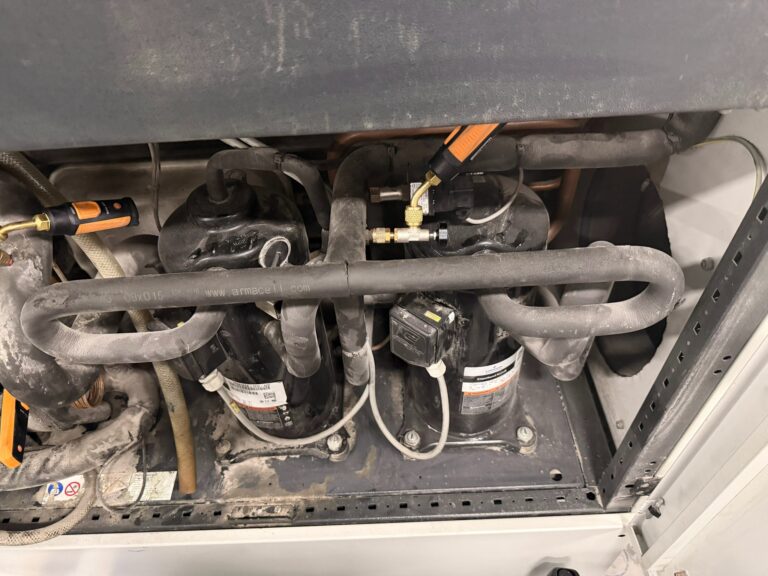
Industrial Chiller Commissioning: Checklist Before the First Start
The first start of an industrial chiller decides a lot about its next fifteen years. A unit that is started with dirt in the water circuit, the wrong phase sequence, air in the evaporator or a compressor without preheated oil may run, but it starts its life with damage that shows up later as flow alarms, worn bearings or a failed plate heat exchanger. Commissioning is more than pressing the start button. This checklist shows what has to be ready before the service engineer arrives, what is checked during commissioning and which documents you should receive afterwards.
Before the engineer arrives: what the site must prepare
Most delays at commissioning are caused by incomplete preparation, not by the chiller. A day lost on site costs time and travel. Check these points with your installer before you book the date.
| Area | Requirement | Why it matters |
|---|---|---|
| Foundation and access | Level base, anti vibration mounts installed, service clearance as per manual | Vibration, condenser airflow, access for repairs |
| Power supply | Main supply connected, cable sized, protection rated, voltage measured | Undervoltage and wrong protection cause trips and motor damage |
| Crankcase heaters | Unit powered 12 to 24 hours before start, depending on manufacturer | Prevents refrigerant in the compressor oil at first start |
| Hydraulic circuit | Piping flushed with the chiller bypassed, filled, vented, pressure tested | Construction debris destroys plate heat exchangers within hours |
| Strainer | Installed in front of the evaporator, clean | Protects the evaporator, required by most manufacturers for warranty |
| Fluid | Water quality or glycol concentration documented | Frost protection and corrosion |
| Load | Process or consumers able to take cooling during commissioning | Without load the chiller cannot be tested and adjusted |
| Controls interface | Enable signal, alarm outputs and BMS connection wired | Function test of all signals at commissioning |
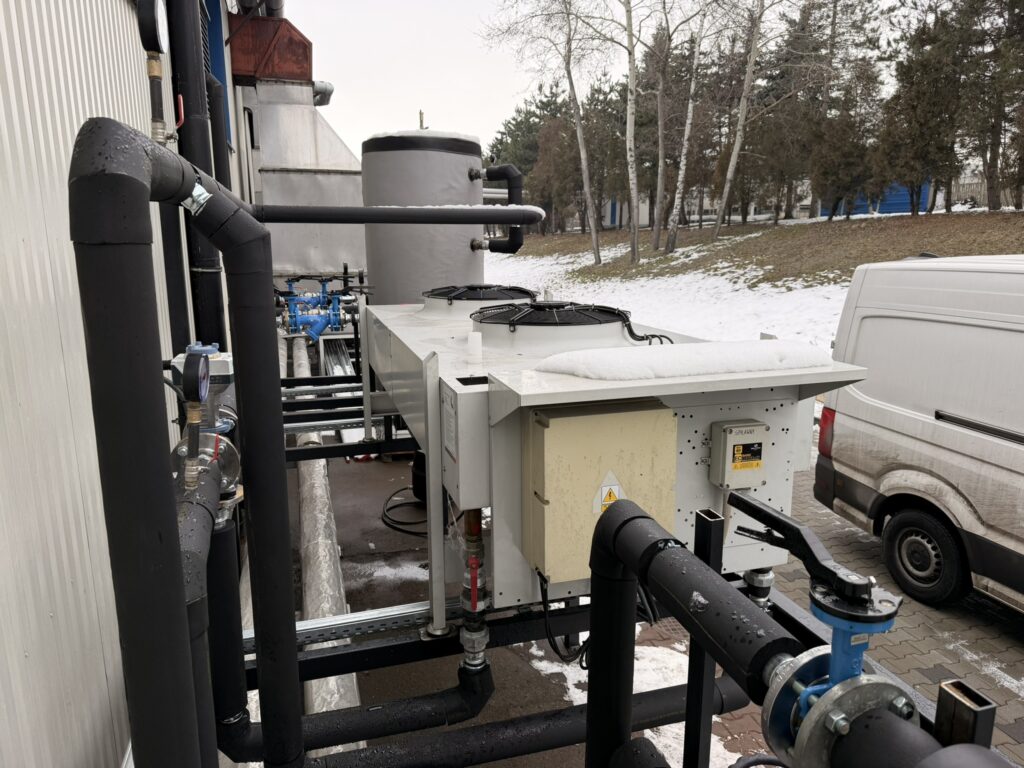
What happens during commissioning
- Visual inspection: transport damage, oil traces, loose components, fan guards, labels and documentation on the unit.
- Electrical checks: supply voltage on all phases, phase sequence, tightness of terminals, settings of protection devices.
- Refrigerant circuit: standing pressure check, leak test of joints that may have moved during transport, position of service valves. Under the F-gas Regulation (EU) 2024/573 this work is performed by certified personnel.
- Hydraulic side: measurement of flow and pressure drop over the evaporator, comparison with the design data, check of the flow switch setting.
- First start: compressor rotation, start current, suction and discharge pressures, superheat and subcooling, oil level.
- Operation under load: stable supply temperature, behaviour of capacity control, fan speed control, response to load changes.
- Safety devices: test of high and low pressure switches, flow switch, freeze protection and emergency stop.
- Controller setup: setpoints, alarm limits, time and date, remote enable, BMS points.
- Handover: instruction of the maintenance team, basic operation and alarm handling.
Documents you should receive
- Commissioning report with measured values and settings.
- Entry in the equipment logbook, including refrigerant type and charge in kg and tonnes CO₂ equivalent.
- Information on the required leak check interval for this unit.
- List of open points, if any, with responsibility.
Keep these documents. Manufacturers often ask for the commissioning report in warranty cases, and the authorities may ask for the equipment records.
The most common commissioning problems we see
- Piping not flushed, strainer full of welding beads after the first hour.
- Air pockets at high points causing flow alarms.
- Flow far below design because of undersized pumps or closed balancing valves.
- Unit not powered in advance, compressor start blocked or started with cold oil.
- No real load available, so capacity control cannot be tested.
Costs
Commissioning is quoted per unit, depending on size and number of circuits. Work on site is charged at 115 EUR net per hour plus travel at 0.75 EUR net per km. If a unit has already been started by others and shows problems, we offer diagnostics from 800 EUR net. See our chilled water installations and planned maintenance pages.
Frequently asked questions
Can our installer start the chiller instead of a refrigeration engineer?
How long does commissioning take?
Do you commission chillers bought from other suppliers?
What do you need before booking a date?
Planning the start of a new chiller? Send us the unit data and the planned date through the contact form or to info@skic.com.pl, and we will send you the preparation checklist and a quote.