
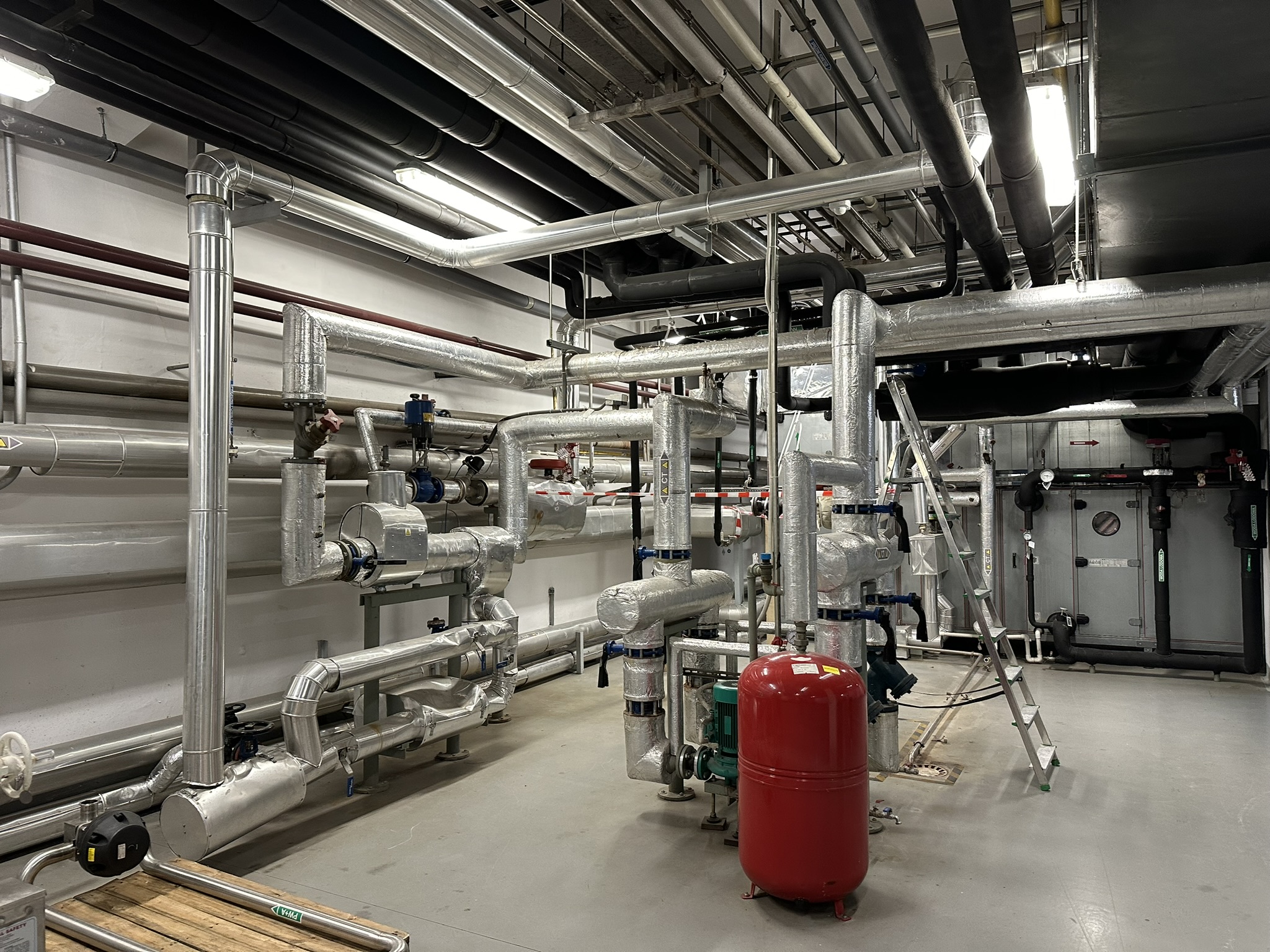
Chilled water installations
Pipework, pumps, buffer tanks and glycol circuits for new and existing chilled water systems: installation, flushing and commissioning.
F-gas company certificate. A report with measurements after every visit. Mobile service in Poland and the EU.
A good chiller in a poor installation will never work well. Undersized pipes, missing buffer tanks, air pockets, wrong pump selection and missing measuring points cause most of the problems we later diagnose as chiller faults. SKiC builds and modernises chilled water and glycol installations for production plants and buildings, from the connection of a single new chiller to complete systems with several consumers.
What we build
| Scope | Details |
|---|---|
| Pipework | Steel, stainless steel and press fittings, insulation with vapour barrier |
| Pumps | Selection, installation, standby pumps, inverter control |
| Buffer tanks | Sizing for stable operation and short cycling prevention |
| Glycol circuits | Filling, concentration, separation from water circuits by heat exchangers |
| Free cooling | Dry coolers, three-way valves, control logic |
| Measuring points | Thermometers, pressure gauges, flow meters, service valves |
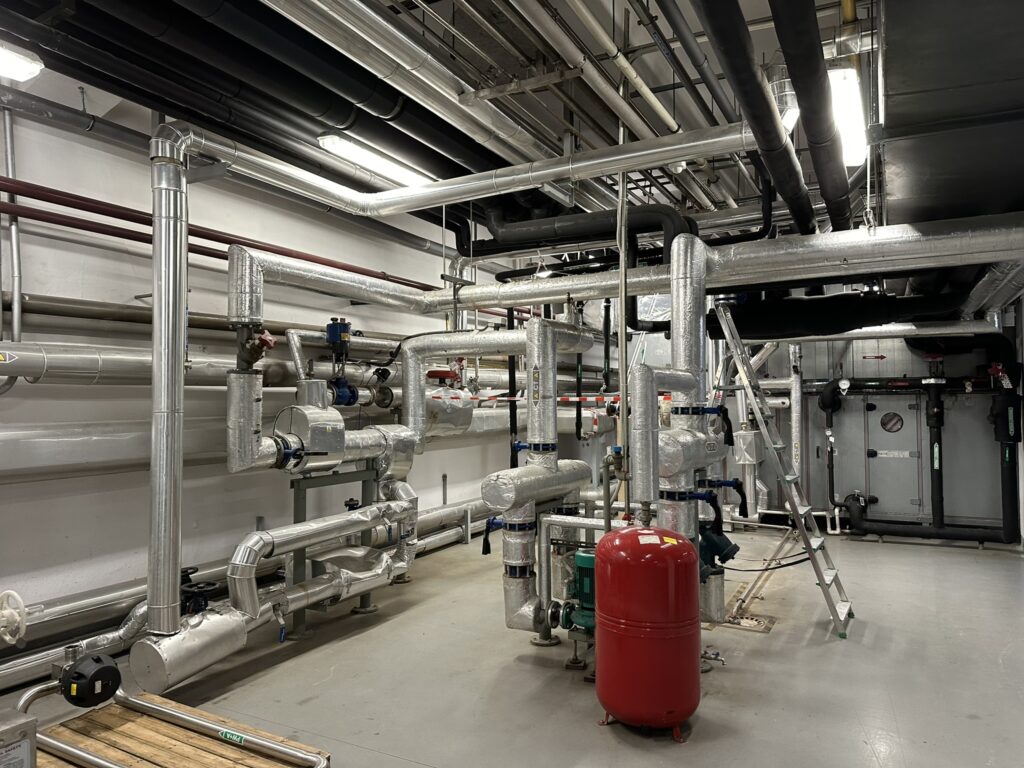
Design decisions that matter later
Water volume
Every chiller needs a minimum water volume to run without frequent starts. In small process circuits the volume is often too low and a buffer tank is necessary.
Pipe sizing and pressure drop
Pipes that are too small raise the pressure drop, the pump energy and the noise. Pipes that are too large are expensive and slow to react. We size them for the flow the chiller and the consumers need.
Insulation
Chilled water pipes below the dew point must be insulated with a vapour barrier. Wet insulation is useless and causes corrosion under the surface.
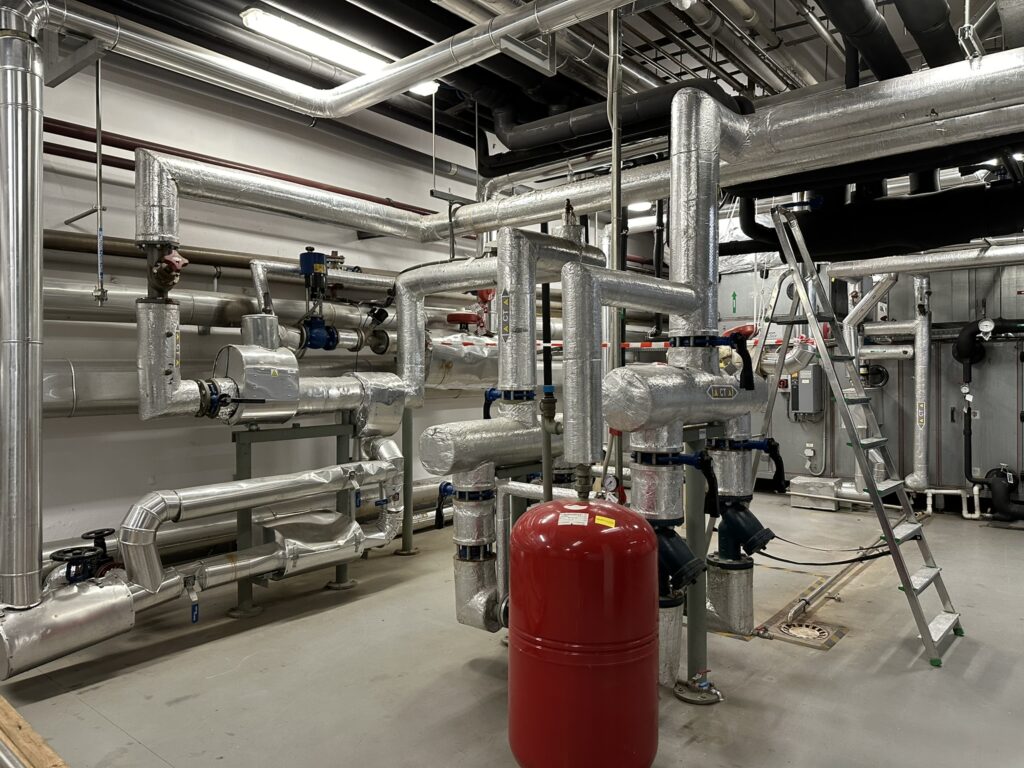
Flushing and commissioning
Before a new or modified installation is put into service, it is flushed, pressure tested, filled and vented. We check the flow on each consumer, set the balancing valves and record the parameters at start-up. The report becomes the reference for later service visits.
Modernisation of existing installations
We add consumers, replace corroded sections, install buffer tanks and standby pumps, and separate glycol and water circuits. Work is planned to keep production stops as short as possible.
| Work outside Poland | Net price |
|---|---|
| Diagnostics on site | from 800 EUR |
| Technician hour | 115 EUR |
| Travel per km | 0.75 EUR |
Questions from maintenance teams
Can you connect a new chiller to our existing pipework?
Yes. We check the existing installation and adapt it to the new unit.
Do you work with stainless steel?
Yes, including installations for food and pharmaceutical plants.
Do you supply the chiller as well?
Yes, together with our partner company ChillerTech.
Planning a new installation?
Send the layout, the consumers and the required temperatures. We will prepare a proposal.
Glycol or water: choosing the medium
Plain water is the most efficient heat transfer medium, but it cannot be used where any part of the circuit is exposed to frost: outdoor pipework, dry coolers, chillers installed on roofs or AHU coils in fresh air intakes. In those cases we design the installation for a glycol mixture, or we separate the outdoor part with a plate heat exchanger and keep water in the building.
- Type of glycol: ethylene glycol has better thermal properties, propylene glycol is used where contact with food or drinking water cannot be excluded.
- Concentration and freezing point: about 30 % ethylene glycol protects to around minus 15 °C, about 35 % propylene glycol to a similar level. We set the freezing point at least 5 K below the lowest expected temperature.
- Effect on capacity: glycol has a lower specific heat and a higher viscosity than water. With 30 % glycol the required flow rises by roughly 10 to 15 %, the pressure drop in pipes and exchangers increases and the effective chiller capacity drops by about 3 to 5 %. Pumps and exchangers must be selected for the actual mixture, not for water.
- Control in operation: we check concentration with a refractometer and the pH at least once a year. Inhibited glycol should stay roughly between pH 8 and 9.5. A falling pH means the inhibitors are used up and corrosion begins.
- Top ups: an installation filled with glycol must never be topped up with water only, because every litre of water raises the freezing point.
Low glycol concentration is one of the common causes of frozen AHU coils. If your air handling units report frost alarms, see our notes on the AHU frost protection alarm.
Typical faults we find in existing installations
When we are asked to connect a new chiller or to find out why an existing system performs poorly, we usually find a similar set of problems. Most of them come from the original installation, not from the chiller itself.
- Air in the system: missing automatic air vents at high points, or vents fitted with closed isolation valves. Air causes gurgling, pump cavitation, unstable flow and flow switch alarms.
- Dirt and debris: welding scale, sand and corrosion products block the plate evaporator and raise its pressure drop. Strainers with a mesh of 0.5 to 1 mm in front of the chiller and a dirt separator are often missing.
- Buffer volume too small: for comfort cooling we plan about 3 to 5 litres of water per kW of cooling capacity, for processes with tight temperature tolerance often 8 to 10 litres per kW. With less volume the compressor starts more than 6 times per hour and the supply temperature swings.
- Expansion vessel with wrong pre-pressure or undersized for a glycol mixture, which leads to pressure drops when the system cools down.
- Uninsulated valves, strainers and pump housings, which drip condensate and corrode.
- Balancing valves never adjusted, so the nearest consumers get too much flow and the furthest too little.
- Flow switches installed in the wrong position or bypassed, leaving the evaporator unprotected.
Before a new or modernised system is handed over we work through the steps in our industrial chiller commissioning checklist. To keep the installation in good condition afterwards, we offer planned maintenance. You can send drawings, photos or a description of the problem through the contact page or to info@skic.com.pl.