
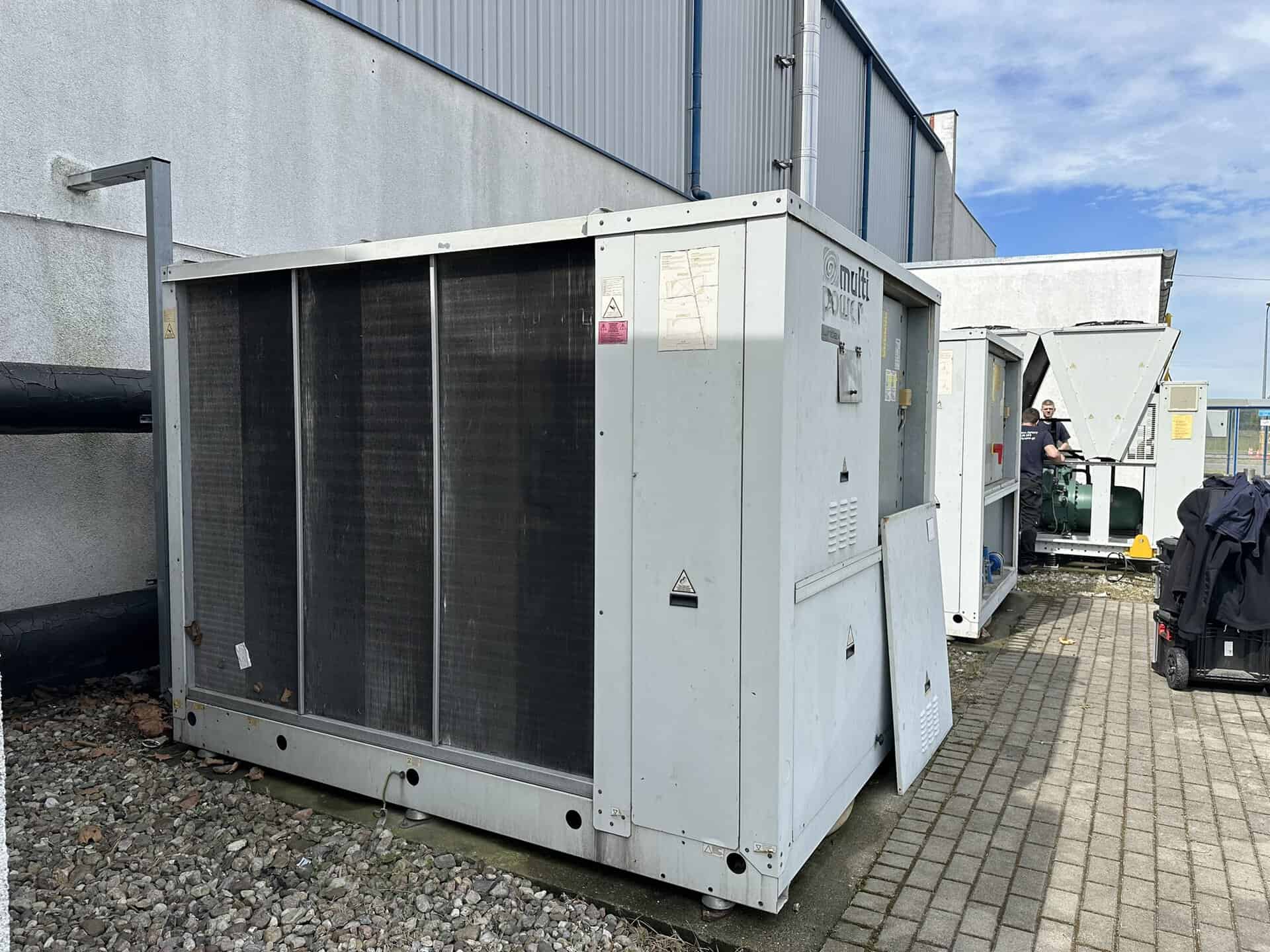
Refrigeration system audit
A refrigeration audit gives you a written assessment of the condition, efficiency and safety of your units and installations, with measured values and a list of actions sorted by priority. It is the basis for budget planning and for decisions between repair and replacement.
F-gas company certificate. A report with measurements after every visit. Mobile service in Poland and the EU.
When an audit is worth ordering
- You have taken over a site or a plant room and the service history is incomplete.
- Breakdowns are becoming more frequent and you need to decide where to invest.
- Energy costs of cooling have risen without a change in production.
- An insurer, an auditor or the group headquarters asks for evidence of F-gas compliance and safe operation.
- The plant will be extended and you want to know how much capacity is really available.
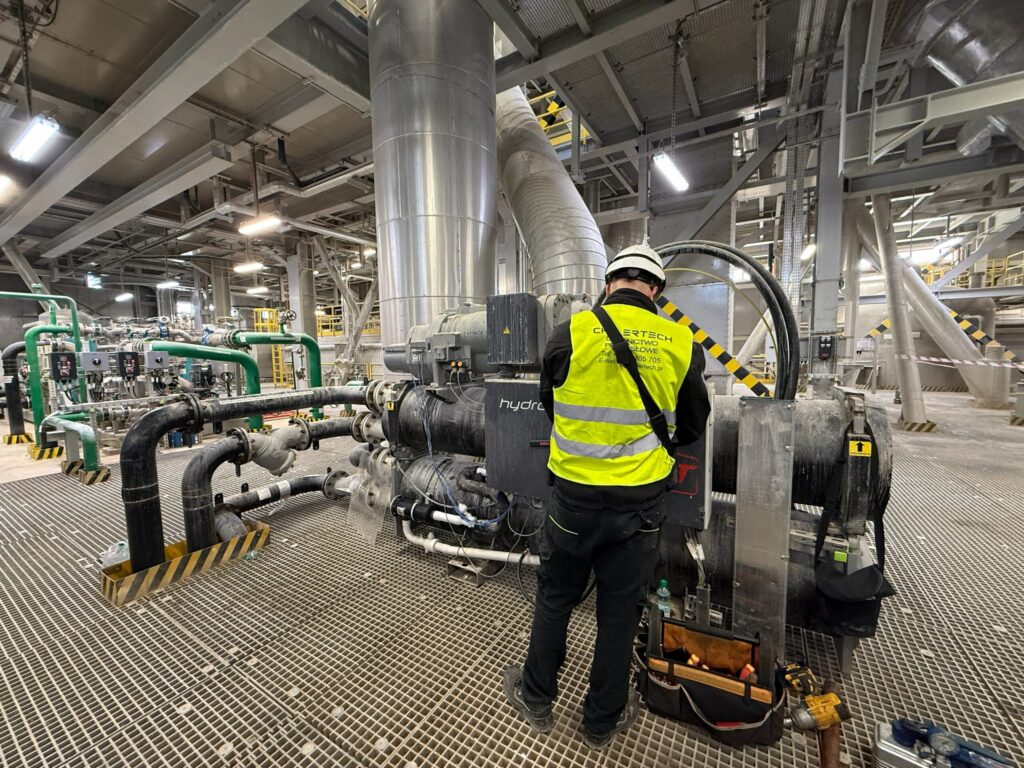
What we assess
Condition of the units
Each unit is inspected and measured under load. We record pressures, superheat and subcooling, discharge temperatures, compressor currents and insulation resistance of the motors. Where the history suggests it, we take an oil sample and test it for acid and moisture. Corrosion of coils and frames, vibration, condition of the electrical panel and the age of key components are documented with photos.
Energy efficiency
Efficiency is judged from measurements, not from catalogue values. Two indicators are particularly telling: the approach temperatures of the heat exchangers and the actual temperature levels of the system.
| Indicator | Good range | Typical reason for a poor value |
|---|---|---|
| Evaporator approach (leaving water minus evaporating temperature) | 2 to 5 K for shell and tube or plate units | Fouling, low charge, oil logging |
| Air-cooled condenser (condensing minus ambient) | 10 to 15 K | Dirty coil, fan fault, air recirculation |
| Water-cooled condenser approach | 1 to 3 K | Scale or biofilm, low water flow |
| Chilled water temperature difference | Close to design, for example 5 K | Oversized pumps, open bypasses, low load |
| Setpoint versus process need | As high as the process allows | Historic setpoints never reviewed |
As a rule of thumb, every kelvin of higher evaporating temperature or lower condensing temperature improves compressor efficiency by about 2 to 4 percent, so a fouled exchanger or a setpoint that is lower than needed costs money every hour.
Leak tightness and F-gas compliance
We check every unit for leaks, verify that the equipment records are complete and that labels show the refrigerant, charge and CO2 equivalent. The required leak check intervals under Regulation (EU) 2024/573 are compared with the actual practice on site.
| Charge in t CO2 eq. | Without leak detection system | With leak detection system |
|---|---|---|
| 5 to below 50 | every 12 months | every 24 months |
| 50 to below 500 | every 6 months | every 12 months |
| 500 and more | every 3 months | every 6 months, system mandatory |
For example, a chiller with 30 kg of R410A (GWP 2088) holds 62.6 t CO2 eq. and needs a check every 6 months, while the same charge of R32 (GWP 675) gives 20.3 t and a 12-month interval.
Safety
We check pressure relief valves and their replacement dates, high pressure switch settings and function, the status of inspections of pressure equipment, refrigerant detection in machine rooms where required, and access and lighting for safe service.
The report and the action plan
The audit ends with a written report: a summary for management, a sheet for every unit with measured values and photos, and an action list. Each action has a priority and a cost range.
- Priority A: safety or legal non-compliance, or a high risk of breakdown. Act now.
- Priority B: actions that reduce energy costs or the risk of failure within the next season.
- Priority C: modernisation to plan in the medium term, such as replacing units on high-GWP refrigerants.
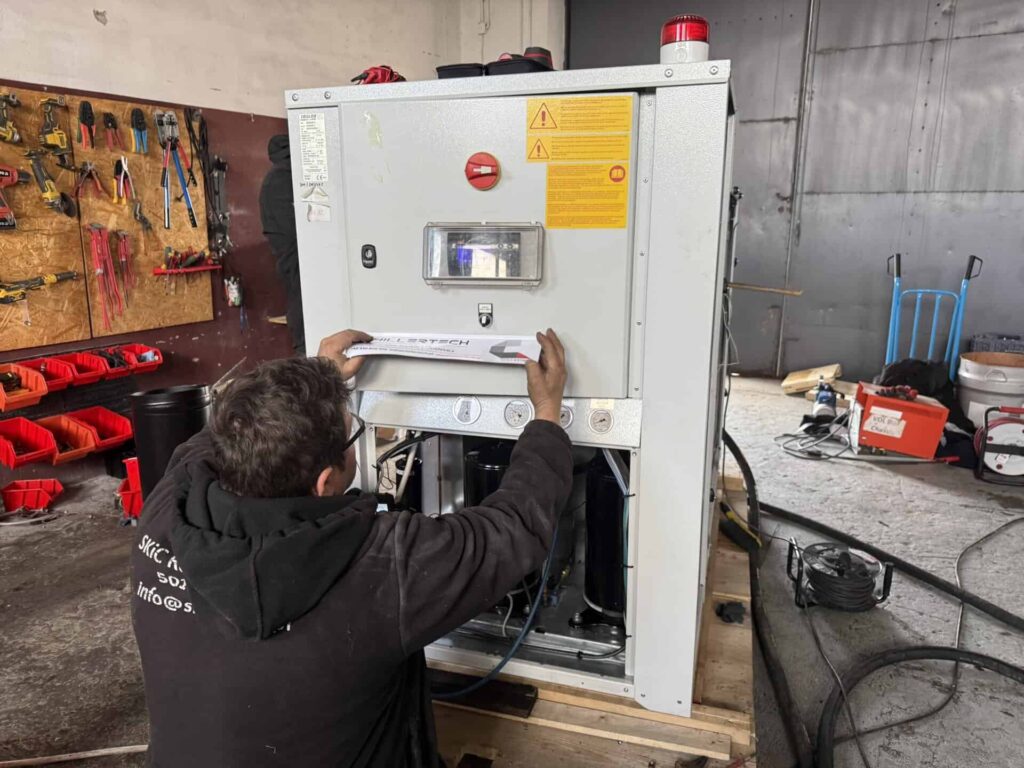
How to prepare for the audit
The more history we receive in advance, the more the day on site is spent on measurements instead of searching for documents. Useful materials include:
- A list of units with location, model and refrigerant, even if incomplete.
- Equipment records and the last leak check reports.
- Service reports and invoices for repairs from the last two or three years.
- Electricity consumption of the plant room or of the cooling feeders, if metered.
- Process requirements: which temperatures the production really needs and when.
We also ask for one person from maintenance to accompany the team for an hour or two. Operators usually know which unit is noisy in the morning or which alarm returns every summer, and that knowledge points the measurements in the right direction.
The action list can be turned directly into a schedule of planned maintenance. Where repairs are needed, they are carried out by our chiller service teams, and where replacement makes more sense we prepare the design of the new system.
Questions from maintenance teams
How long does an audit take?
A plant room with two or three chillers is usually audited in one day on site, with the report sent afterwards. Larger sites are split into stages agreed in advance.
Do the units have to run during the audit?
Yes, efficiency and refrigerant circuit measurements only make sense under load. If the load is low on the day, we note it and interpret the values accordingly.
Can the audit be done by a company that will later quote the repairs?
The report contains the measured values and photos, so any competent company can verify the findings. You are free to order the repairs from whoever you choose.
Do you audit equipment of all brands?
Yes. We are independent and not tied to any manufacturer.
Need a clear picture of your cooling plant?
Tell us how many units you have and where they are, and we will propose the audit scope and a date.