
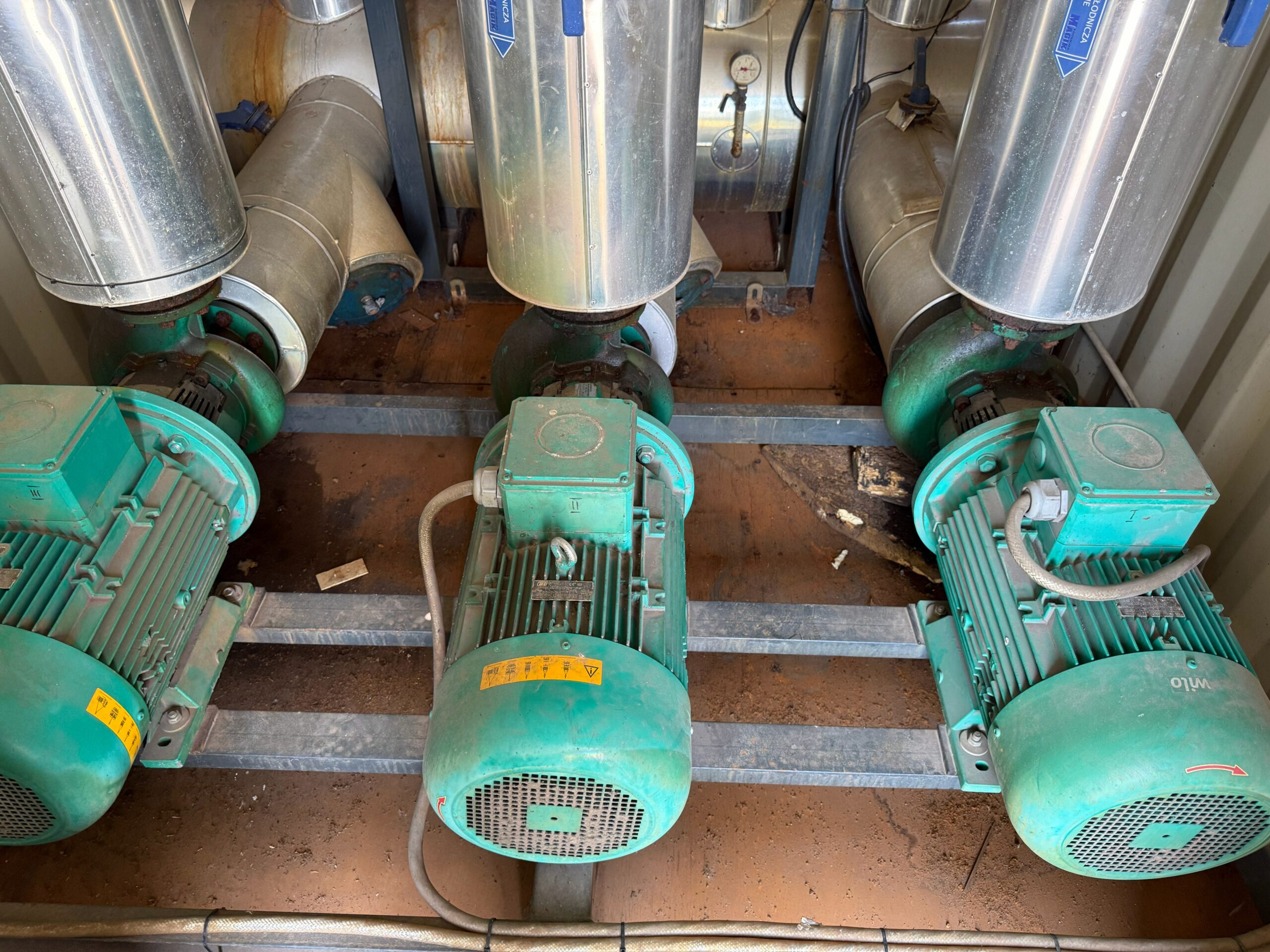
CNC machine cooling
A CNC machine is only as accurate as its temperature is stable. SKiC services and repairs the oil coolers and process chillers that keep spindles, hydraulics and machine structures within about ±1 K.
F-gas company certificate. A report with measurements after every visit. Mobile service in Poland and the EU.
Why machine tools need precise cooling
Steel and cast iron expand by about 11 to 12 µm per metre for every kelvin. On a machining centre with a 1 m long column, a 2 K temperature rise in the structure is enough to move the tool by more than 20 µm, which already exceeds the tolerance of many precision parts. Heat comes from the spindle bearings, the spindle motor, ball screws, the hydraulic unit and the cutting process itself. The cooling system has to take this heat away so that the machine stays at a constant temperature from the first part of the shift to the last.
Typical control modes
Most spindle oil coolers work in follow-up mode: the oil temperature is controlled relative to a reference sensor in the machine bed or in the room, typically with an offset of 0 to minus 2 K and a band of ±0.5 to ±1 K. Others use a fixed setpoint, usually between 20 and 25 °C. The important point is that the reference sensor is in the right place and works, which is not always the case on older machines.
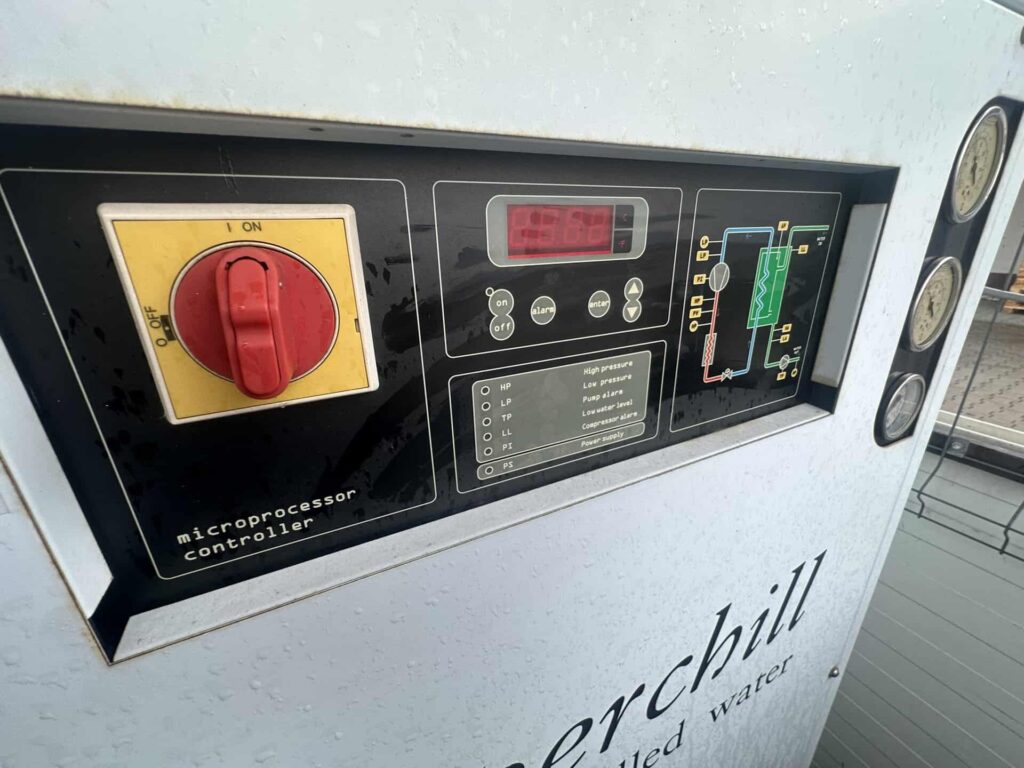
Cooling circuits on a CNC machine
| Circuit | Typical temperature | Typical tolerance | Equipment |
|---|---|---|---|
| Spindle and bearing oil | Machine or room temperature, about 20 to 25 °C | ±0.5 to ±1 K | Oil cooler with follow-up control |
| Spindle motor and linear motors | 20 to 25 °C water or glycol | ±1 K | Water chiller, often 2 to 10 kW |
| Hydraulic unit | 40 to 50 °C oil | ±3 K | Oil to air cooler or oil to water heat exchanger |
| Cutting fluid (emulsion) | 20 to 25 °C | ±2 K | Coolant chiller, plate or coil exchanger |
| Electrical cabinet | Below 35 °C inside | Limit value | Cabinet cooling unit |
In larger machine halls these consumers are increasingly connected to a central chilled water system through plate heat exchangers, with a small local controller per machine. This reduces the number of small refrigerant circuits and moves the heat out of the hall.
Typical failures and what they do to production
- Condenser fouled by oil mist and metal dust. This is by far the most common fault. The condensing pressure rises, capacity drops, the oil temperature drifts upwards in the afternoon and the machine stops on an oil temperature alarm.
- Refrigerant leak on vibrating copper lines or a corroded capillary. The unit runs continuously and still cannot hold the setpoint.
- Faulty hot gas bypass valve or capacity control valve, causing temperature swings of several kelvin.
- Reference or oil temperature sensor out of calibration, so the controller keeps the oil at the wrong temperature without any alarm.
- Worn oil pump, low oil level or a blocked suction strainer, leading to low flow and bearing damage in the spindle.
- Failed condenser fan or a fan capacitor that has lost its capacity.
The production impact ranges from parts out of tolerance, noticed only at the measuring machine, to a stopped machine and in the worst case a damaged spindle. A spindle repair costs many times more than a cooler repair, so an oil temperature alarm should never be acknowledged repeatedly without investigation.
How SKiC services machine tool cooling
On-site diagnostics
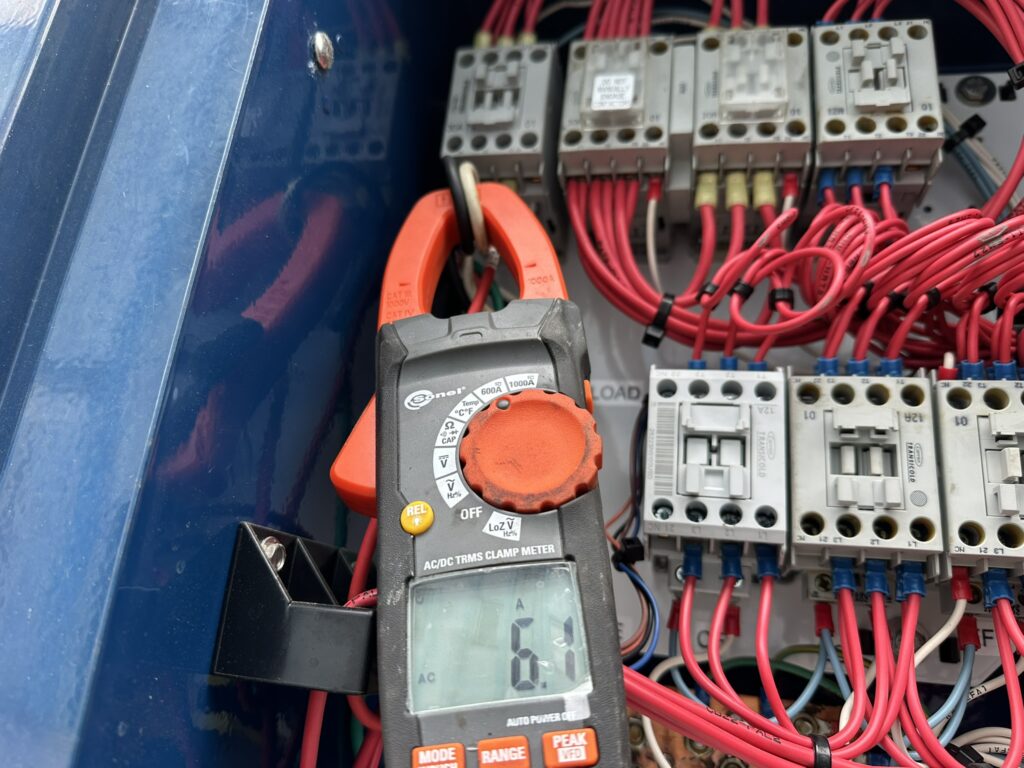
We measure the oil or water temperature at inlet and outlet, the reference temperature, refrigerant pressures, superheat and subcooling, compressor and fan currents and the airflow over the condenser. We compare the controller reading with a reference thermometer, because a sensor that is off by 2 K explains many accuracy complaints.
Workshop repairs in Wałsnów
Small oil coolers are often repaired faster and cheaper on the bench. In the workshop we clean the condenser and the housing, pressure test the circuit with nitrogen, find and braze the leak, replace the filter drier, evacuate and charge by weight, then run the unit under load on a test circuit. More on oil cooler repair.
Replacement and central cooling
Where a cooler uses a refrigerant that is no longer available, or where the compressor is no longer made, we propose a replacement unit of suitable capacity and control mode. For halls with many machines we design a central chilled water system with plate heat exchangers per machine and a single, maintainable chiller plant, see chilled water installations.
Maintenance plan for machine coolers
- Monthly, by the machine operator: visual check, condenser filter mat cleaned, oil level checked.
- Every 6 months, by SKiC: condenser cleaning with suitable cleaner, temperature and pressure measurements, sensor comparison, electrical check.
- Yearly: oil and filter condition, pump check, record of all measured values to compare trends.
Small machine coolers often contain less than 5 t CO2 eq. of refrigerant and are therefore outside the mandatory leak check obligation, but a leak still shows up as a slow loss of accuracy, so we check tightness on every visit.
Questions from maintenance teams
Our parts drift out of tolerance in the afternoon. Is it the cooler?
Often yes. If the oil temperature or the difference to the machine reference rises during the day, the cooler is losing capacity, usually because of a dirty condenser or a rising hall temperature. We log the temperatures over a shift to confirm it.
Can a cooler be repaired if the manufacturer no longer supports it?
In most cases yes. Compressors, fans, valves and controllers can be replaced with equivalent components, and the unit can be converted to a currently available refrigerant if needed.
How long does a workshop repair take?
Typically several working days including the test run. If the machine cannot wait, we check whether a temporary cooler can be connected.
Do you service cabinet cooling units as well?
Yes, as part of a machine cooling visit we check and repair the cabinet cooling units, including condensate drains, which often cause water damage in electrical cabinets.
Keep your machines thermally stable
Send us the cooler model, the alarm messages and the machine type, and we will propose on-site diagnostics or a workshop repair.