
Oil cooler repair
Oil cooler repair for machine tools, presses, injection moulding machines and hydraulic units of all brands. We find out why the oil runs warm, repair the refrigerant and oil circuits on site or in our workshop and test the unit under load.
F-gas company certificate. A report with measurements after every visit. Mobile service in Poland and the EU.
Why oil temperature matters
In a machine tool, spindle and hydraulic oil temperature directly affects dimensional accuracy. Steel expands by about 0.011 mm per metre per kelvin, so a spindle housing that warms by a few kelvin shifts the tool position by more than the tolerance of a precision part. In hydraulic presses and injection moulding machines, oil that runs above about 55 to 60 °C loses viscosity, leaks more internally and ages faster, while seals harden. That is why many machines stop with an alarm when the oil cooler cannot keep up, and why oil cooler repair has to be quick.
Types of oil coolers
Immersion coolers
The evaporator coil sits directly in the oil tank of the machine. The design is simple but the coil collects sludge and metal particles, and the tank level must cover the coil completely.
Circulation coolers with plate heat exchanger
The unit has its own oil pump that draws oil from the machine, pushes it through a brazed plate heat exchanger and returns it. These units allow precise control but are sensitive to oil viscosity and contamination.
Oil to air coolers
Simple fan-cooled radiators without a refrigerant circuit. They can only cool the oil to a few kelvin above room temperature.
Control modes
Spindle coolers often track a reference: the oil is kept a set value above or below the room temperature or the machine bed temperature, typically within 0.1 to 0.5 K. If the reference sensor is placed in the sun, next to a door or on a warm wall, the cooler follows the wrong temperature and the machine drifts even though the cooler reports no fault. Hydraulic coolers usually work with a fixed setpoint, commonly 35 to 45 °C.
Typical faults and how we check them
| Symptom | Possible causes | What we check |
|---|---|---|
| Oil too warm, no alarm on the cooler | Dirty condenser, room too hot, capacity too small for a changed process | Condensing temperature, air inlet temperature, oil flow and temperature difference |
| High pressure alarm | Condenser fan fault, blocked condenser, overcharge | Fan current and speed, coil condition, subcooling |
| Low pressure alarm | Refrigerant leak, low oil flow over the evaporator, expansion valve fault | Superheat, oil pump pressure, leak test |
| Flow alarm | Worn gear pump, blocked suction strainer, cold oil too viscous at start | Pump pressure, strainer, oil grade against cooler limits |
| Foaming or rising oil level in tank | Refrigerant leaking into oil through a cracked plate exchanger | Pressure test of the exchanger, oil sample |
| Temperature hunting | Sensor drift, controller parameters, hot gas bypass fault | Sensor against a reference, control parameters |
A leak inside a brazed plate exchanger is the most serious fault: refrigerant enters the oil, or oil enters the refrigerant circuit and reaches the compressor. After such a failure the exchanger is replaced, the refrigerant circuit is flushed, the filter drier changed and the machine oil assessed by the machine owner.
Cleaning
Condensers of oil coolers sit in machine halls full of oil mist and fine dust, which forms a sticky layer that a brush or compressed air does not remove. We use degreasing coil cleaners and rinse thoroughly. On the oil side, sludge in immersion coils and plate exchangers is removed with a suitable flushing fluid, compatible with the machine oil, when the unit is in the workshop.
Workshop repairs
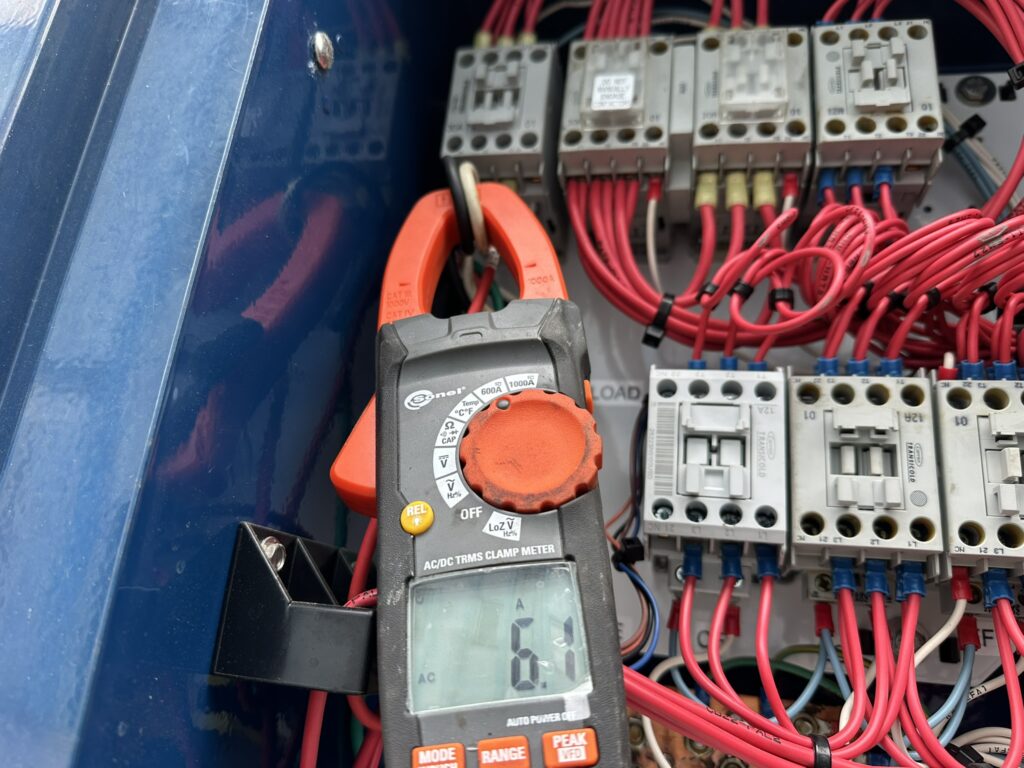
Oil coolers are compact, so most repairs beyond a cleaning or a sensor replacement are faster in our workshop in Wałsnów. The process:
- Receipt, photos and a check of the reported fault.
- Pressure test of the refrigerant circuit with nitrogen and leak location.
- Repair: compressor, fan, expansion device, plate exchanger, oil pump, controller or sensors.
- Brazing to EN 13585, replacement of the filter drier, evacuation and charging by weight.
- Test run with a heat load and record of pressures and oil temperatures.
- Report with the measurements and the return of the unit.
Small charges are typical for oil coolers. A unit with 1.2 kg of R134a holds 1.7 t CO2 eq. and is below the leak check threshold, but the repair still requires a certified company, recovery of the refrigerant and records. Our company holds F-gas certificate FGAZ-E27/0001/21.
Water and glycol coolers for the same machines are covered on the industrial coolers page, and central systems serving many machines under process cooling. Oil pumps of the coolers are regenerated as described on our pump repair page.
Questions from maintenance teams
Can you repair an oil cooler built by the machine manufacturer?
Yes. Most of these units use standard compressors, exchangers and controllers. We need the model and, if possible, the electrical diagram.
How long does a workshop repair take?
It depends on the parts. Repairs with standard parts are usually completed faster than with special controllers ordered from the manufacturer; we give the expected time after the inspection.
Can we use a different oil grade in the machine?
Only after checking the oil pump and exchanger limits of the cooler. A more viscous oil can trip the flow switch at cold start.
Is a replacement unit available while ours is repaired?
Our partner company ChillerTech supplies new and rental cooling units; ask us about availability for your capacity when sending the enquiry.
Machine stopped on oil temperature?
Send the cooler nameplate and the alarm, and we will propose a site visit or a workshop repair.