
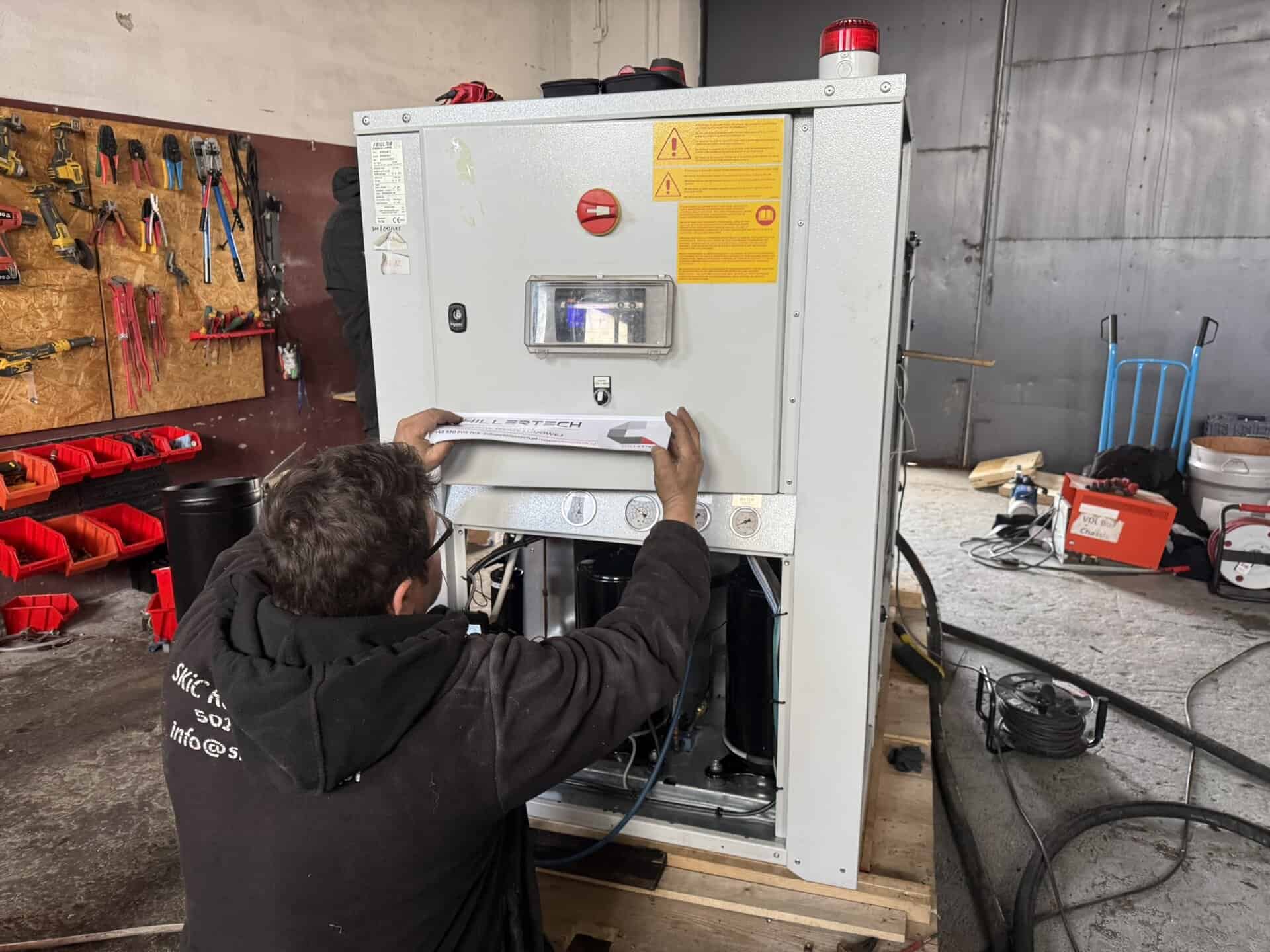
Production line cooling
Production lines need cooling that holds its supply temperature when the load jumps and keeps running when one component fails. SKiC services and modernises process chillers, buffer tanks, pumps and controls for chilled water and glycol systems.
F-gas company certificate. A report with measurements after every visit. Mobile service in Poland and the EU.
What a production line expects from its cooling
Most lines are supplied from a central system: one or more process chillers, a buffer tank, a pump group and a distribution network to extruders, coating stations, welding transformers, ovens with cooled sections, compressors and packaging machines. The typical design is chilled water at 10 to 15 °C supply with a 5 K temperature difference, or a glycol mixture at 0 to 7 °C where a consumer needs colder water or the pipework runs outdoors.
The quality criterion is the stability of the supply temperature. For general machine cooling ±1 K is acceptable; extrusion, lamination and coating processes often need ±0.5 K. A chiller sized exactly to the nominal load with only two compressor steps will not achieve this, because the load on a line changes every time a machine starts, stops or changes product.
Load profile and partial load
Lines rarely run at design load. Night shifts, format changes and planned stops mean that a chiller spends most of its life at 30 to 70 percent. At low load a scroll chiller without inverter control starts and stops its compressors frequently, the supply temperature swings and the compressors wear out. The remedy is enough water volume in the system and a control strategy that matches capacity steps to the load.
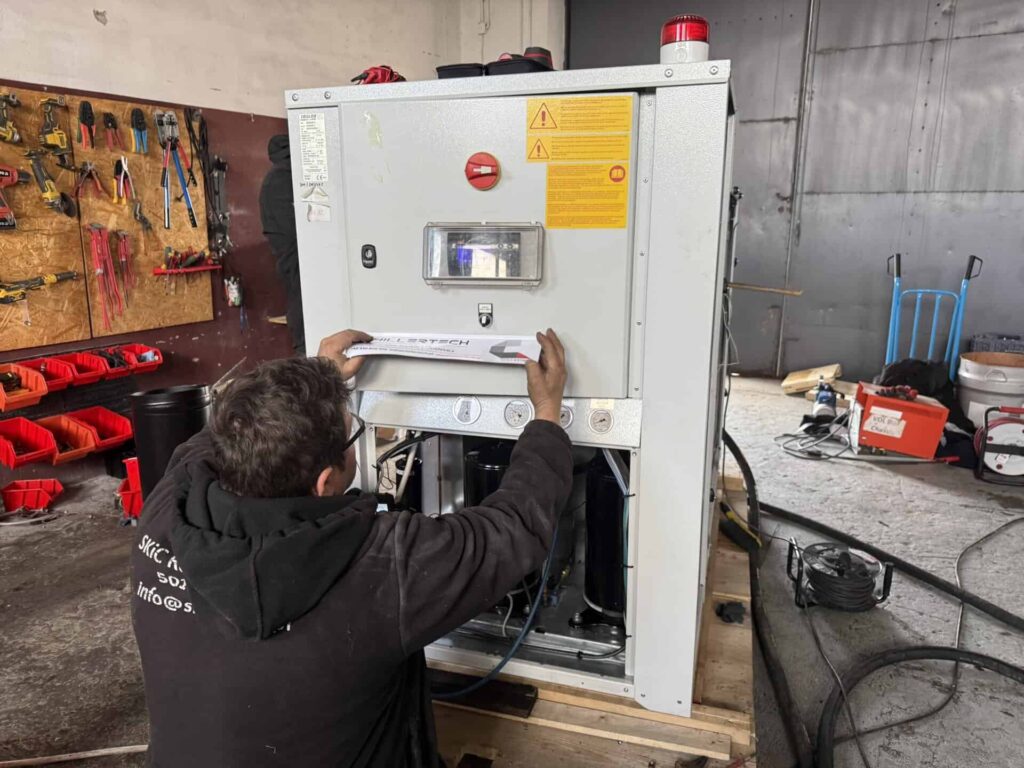
Equipment in a typical line cooling system
- Process chillers, air-cooled or water-cooled, with scroll or screw compressors, often in a lead and lag arrangement.
- A buffer tank sized at roughly 5 to 10 litres per kW of cooling capacity, so that every compressor start runs for at least several minutes.
- Primary pumps for the chillers and secondary pumps for the consumers, ideally as duty and standby pairs.
- Plate heat exchangers that separate sensitive machine circuits from the main loop.
- Strainers, air separators, expansion vessels and a pressure maintenance unit.
- Dry coolers or free cooling modules that take over part of the load in the cold season.
- A PLC or building management controller with alarm outputs.
Redundancy: how much is enough
Redundancy should follow the cost of a stop. If one hour without cooling costs more than a second chiller, the system should be N+1: with any one chiller out of service, the remaining units cover the full load. The same applies to pumps: a single pump without standby is the most common single point of failure we find on production sites. Automatic changeover on a fault and weekly rotation keep both pumps in working order.
Less visible weak points are the power supply (both chillers fed from one switchboard), a single supply temperature sensor that controls the whole plant, and a buffer tank that cannot be bypassed during repairs. Our refrigeration system audit lists these points with priorities.
Typical failures and their effect on production
| Symptom | Common cause | Effect on the line |
|---|---|---|
| High pressure trip on hot days | Fouled condenser coil, failed fan, overcharge | Loss of capacity in the afternoon, line slowdown |
| Low flow or flow switch alarm | Blocked strainer, worn pump, air in the system | Chiller stops, all consumers warm up |
| Freeze protection trip | Glycol concentration too low, low flow through the evaporator | Risk of a cracked plate evaporator, long downtime |
| Supply temperature swings | Too little water volume, wrong control parameters | Quality deviations, scrap |
| Low pressure trip, slow capacity loss | Refrigerant leak | Repeated trips, compressor damage if ignored |
| Compressor failure | Liquid floodback, short cycling, electrical fault | Capacity reduced or chiller out for days |
Most of these faults announce themselves weeks in advance in the measurements: a condensing temperature creeping up, a rising pressure drop across a strainer, superheat that is unstable. That is why we measure on every visit and keep the values in the report, so the next technician can compare.
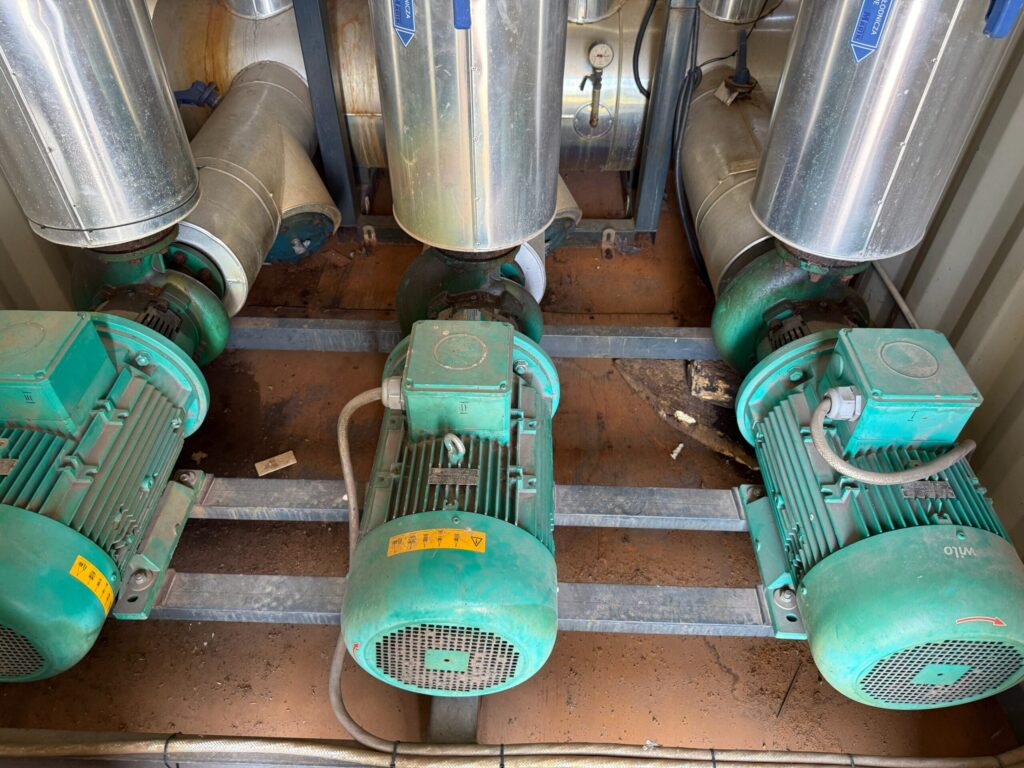
How SKiC services and modernises line cooling
Diagnostics with measurements
We record suction and discharge pressures, superheat and subcooling, evaporator and condenser approach temperatures, water temperatures and the temperature difference across each chiller, pump currents and pressure differences. From these values we can tell whether the problem is refrigerant side, water side or control side, and you get a report after every visit.
Repairs
Compressor replacement with cause analysis, leak search, brazing under nitrogen, evacuation and charging by weight, expansion valves, fans, pumps and sensors. Pump overhauls are covered on water and hydraulic pump repair.
Modernisation
- Adding or enlarging a buffer tank to end short cycling.
- Converting single pumps to duty and standby pairs with automatic changeover.
- EC fans and inverter pumps to reduce energy use at partial load.
- Free cooling with dry coolers for circuits running at 12 °C supply or higher.
- A Siemens PLC sequence controller for several chillers with HMI, web visualisation and SMS or e-mail alarms, see controls and remote monitoring.
If a chiller has to be taken out for a longer repair, a temporary unit can be supplied by our partner ChillerTech.
Questions from maintenance teams
Which supply temperature should our line cooling run at?
As high as the most demanding consumer allows. Every kelvin higher on the supply improves chiller efficiency by roughly 2 to 3 percent and extends the free cooling season. We check the real requirement of each consumer before suggesting a change.
How often should the glycol concentration be checked?
At least once a year before winter, and after every refill with water. We measure the freezing point with a refractometer and check pH and inhibitor condition.
Can you add a second chiller to an existing system?
Yes. We check the hydraulics, the electrical supply and the controls, then propose how to connect the unit so that both chillers share the load and either can run alone.
How often should a production chiller be inspected?
For continuous operation we recommend two inspections a year, one before the summer season. F-gas leak checks follow Regulation (EU) 2024/573: a chiller with 30 kg of R410A (62.6 t CO2 eq.) needs a check every 6 months, or every 12 months with a leak detection system.
Do you also install the pipework?
Yes, in steel, stainless steel and press fittings, including pumps, buffer tanks and insulation.
Make your line cooling predictable
Send us the layout of your system and the alarm history, and we will plan diagnostics with measurements and a list of improvements.