Water-Cooled vs Air-Cooled Chillers for Process Cooling
When a plant needs process cooling for injection moulding, extrusion, chemical reactors or food production, one of the first technical decisions is whether the chiller should reject heat to air or to water. Both solutions work, but they behave very differently in energy use, footprint, maintenance and risk. Choosing the wrong one usually does not show up on day one. It shows up in the third summer, when the chiller trips on high pressure in a heatwave, or in the energy bill that is 20 % higher than planned. This article compares both options from the perspective of a service company that maintains them every day.
How the two concepts differ
An air-cooled chiller has a finned condenser and fans built into the unit. The refrigerant condenses directly against outdoor air. It is a self-contained package: power, chilled water piping and it runs.
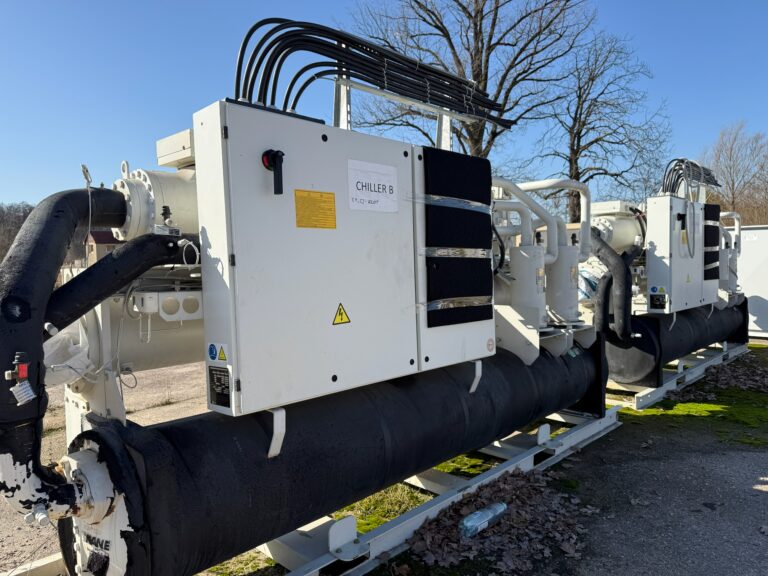
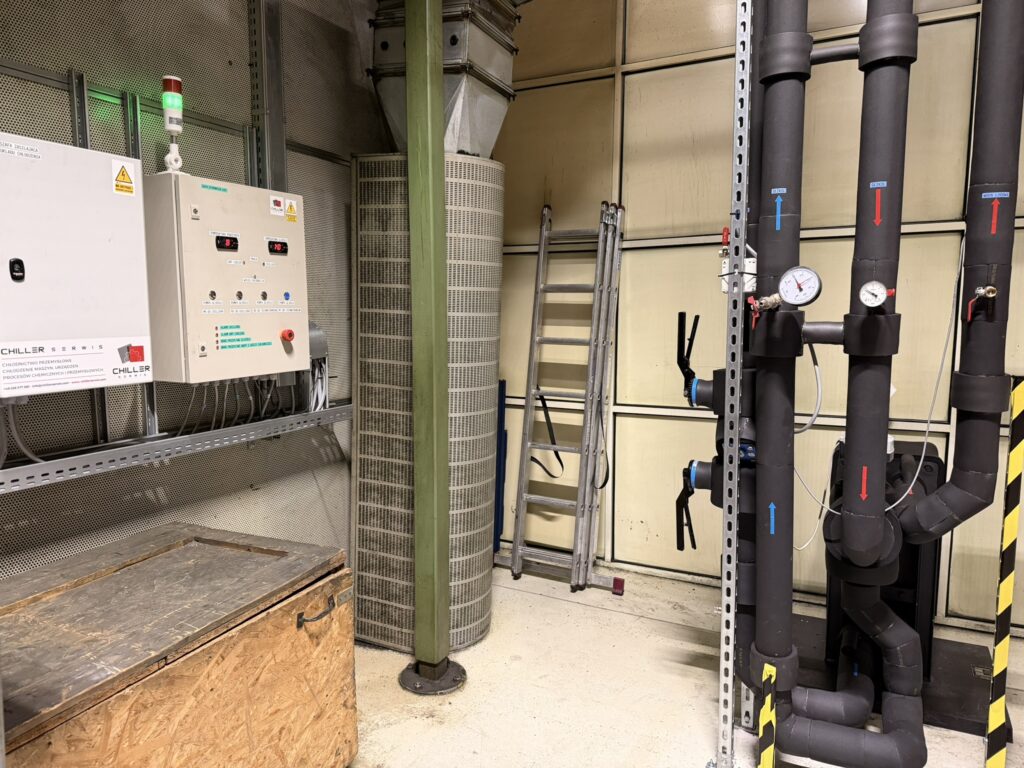
A water-cooled chiller condenses the refrigerant in a shell and tube or plate heat exchanger. The heat goes into a condenser water circuit that rejects it through a cooling tower, a dry cooler or an adiabatic cooler. The chiller itself is usually installed indoors in a plant room, the heat rejection equipment outside.
Comparison for process cooling
| Criterion | Air-cooled | Water-cooled |
|---|---|---|
| Energy efficiency at full load | Lower, condensing temperature follows the dry bulb air temperature | Higher, especially with a cooling tower; typically 20 to 40 % less compressor power at peak |
| Behaviour in a heatwave | Capacity drops, high pressure trips possible above design temperature | More stable, depends on the design of the heat rejection circuit |
| Investment | Lower, one package | Higher: chiller, condenser pump, heat rejection, piping, water treatment |
| Space | Outdoor area or roof, no plant room | Plant room plus outdoor space for the cooler |
| Typical capacity range | Up to approximately 1.5 MW per unit | From several hundred kW to many MW |
| Maintenance | Condenser cleaning, fans, controls | Water treatment, condenser tube cleaning, cooling tower hygiene, more pumps and valves |
| Noise on site | Fans on the unit | Chiller indoors, noise from the cooler outside |
| Free cooling | Possible with integrated free cooling coil | Easy to combine with a dry cooler for winter free cooling |
When air-cooled is the right choice
- Capacity up to a few hundred kW and moderate running hours.
- No plant room available and no staff to look after a water circuit.
- Sites where water consumption or Legionella risk from cooling towers is not acceptable.
- Temporary or relocatable cooling, for example during a production ramp up.
When water-cooled pays back
- High capacity and long running hours, for example three shift production all year.
- Processes that need stable supply temperature even on the hottest days.
- Sites with an existing cooling water circuit or a need for heat recovery from the condenser side.
- Restrictions on noise or space on the roof.
A typical scenario: a plant runs several air-cooled chillers of a few hundred kW each on a roof. Every summer one of them trips on high pressure during afternoon peaks and stops production. In such cases a water-cooled solution with a closed dry cooler and adiabatic pre-cooling usually removes the trips and lowers compressor power at peak noticeably. The investment is higher, so the decision should be based on the cost of production stops and the running hours, not on the purchase price alone.
The hidden cost of water-cooled systems
Water-cooled chillers are only as efficient as their condenser water circuit. Scale and biofilm in the condenser tubes raise the condensing temperature just like dirt on an air-cooled coil. Open cooling towers need water treatment and hygiene inspections. If nobody on site is responsible for this, the efficiency advantage disappears within a few years. A closed dry cooler or hybrid cooler reduces the water treatment effort and is a common compromise in industry.
Questions to answer before you decide
- What supply temperature does the process need, and how stable must it be?
- How many full load hours per year will the chiller run?
- What is the highest outdoor temperature at the site in the last ten years?
- Is there a plant room, roof space or yard area, and what are the noise limits?
- Who will maintain the water circuit?
- Can condenser heat be reused for heating, washing or process water?
We help with this decision as part of our chiller selection and supply service, and we maintain both types under our process cooling and dry cooler service.
Costs
A site visit to assess an existing installation and its cooling load is billed as diagnostics from 800 EUR net with a written recommendation. Additional work is charged at 115 EUR net per hour plus travel at 0.75 EUR net per km. Equipment proposals are prepared individually.
Frequently asked questions
Can an existing air-cooled chiller be converted to water-cooled?
Is a cooling tower required for a water-cooled chiller?
Which option is better for free cooling?
Do you service both types?
Planning new process cooling or struggling with summer trips? Send us your cooling load, process temperatures and site location through the contact form or to info@skic.com.pl, and our engineers will come back with a recommendation.