
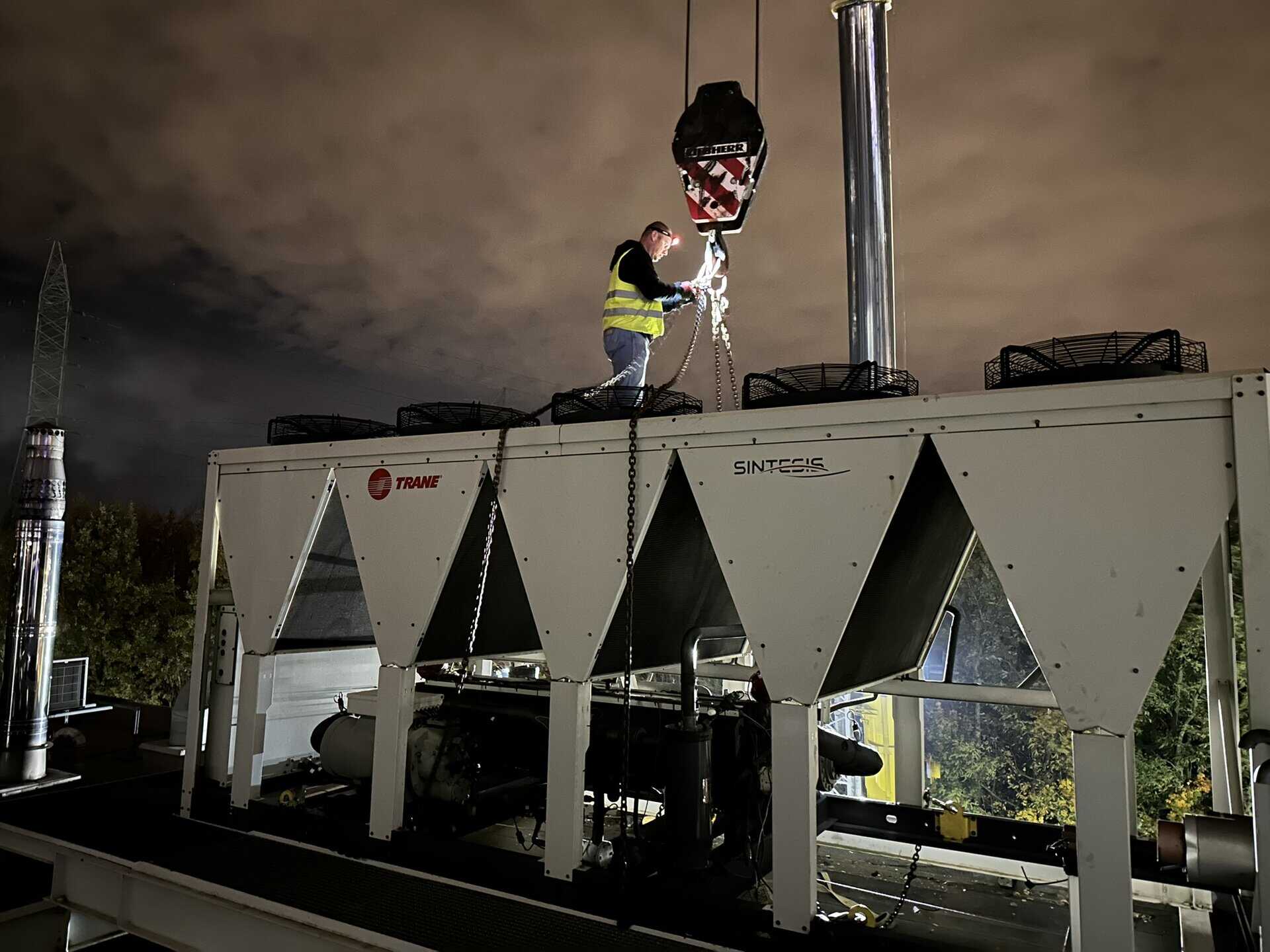
Chiller selection and supply
Together with our partner company ChillerTech we select and supply new and refurbished chillers, then install, start up and service them. Selection is based on your measured load and temperatures, not on a catalogue figure.
F-gas company certificate. A report with measurements after every visit. Mobile service in Poland and the EU.
A chiller that is too large cycles on and off, wears its compressors and controls temperature poorly. One that is too small runs flat out on the hottest days and trips on high pressure exactly when production needs it most. Correct selection starts with data from your plant. SKiC brings the service view (what fails, what is hard to maintain, what the existing installation can take) and ChillerTech, our partner company, supplies new and refurbished units.
Who does what
- SKiC: survey of the site and the existing installation, load and temperature analysis, hydraulic and electrical connection, controls, start-up and service after supply.
- ChillerTech: supply of new and refurbished chillers matched to the selection, and rental units when a temporary solution is needed.
You have one point of contact for the technical side, and the unit is serviced afterwards by the same team that selected and installed it.
Selection criteria
These are the parameters we check before we propose a unit. Each of them can change the choice of model, compressor type or refrigerant.
| Criterion | What we check | Why it matters |
|---|---|---|
| Cooling capacity | Measured load profile, peak and minimum, future expansion | Oversizing causes short cycling, undersizing causes trips at peak load |
| Supply and return temperatures | Process requirements, for example 7/12 °C for comfort or 15/20 °C for machines | Higher supply temperature means higher efficiency and more free cooling hours |
| Fluid | Water or glycol, concentration, required freeze protection | Glycol reduces capacity and changes pump and heat exchanger selection |
| Ambient conditions | Maximum summer temperature at the unit location, sun, recirculation of hot air | Capacity of air-cooled units falls as ambient rises |
| Noise | Distance to neighbours and offices, local limits | May require low-noise fans, night mode or acoustic enclosures |
| Refrigerant GWP | Requirements of Regulation (EU) 2024/573, future availability | Lower GWP refrigerants such as R32 (675), R454B (466), R513A (631) or R290 (3) reduce regulatory risk |
| Free cooling | Number of hours per year with outdoor temperature below the return temperature | Can cut compressor running hours significantly in processes running all year |
| Redundancy | Consequences of a stop, N+1 configuration, number of compressors and circuits | A single unit with one circuit is a single point of failure |
Load and temperature analysis
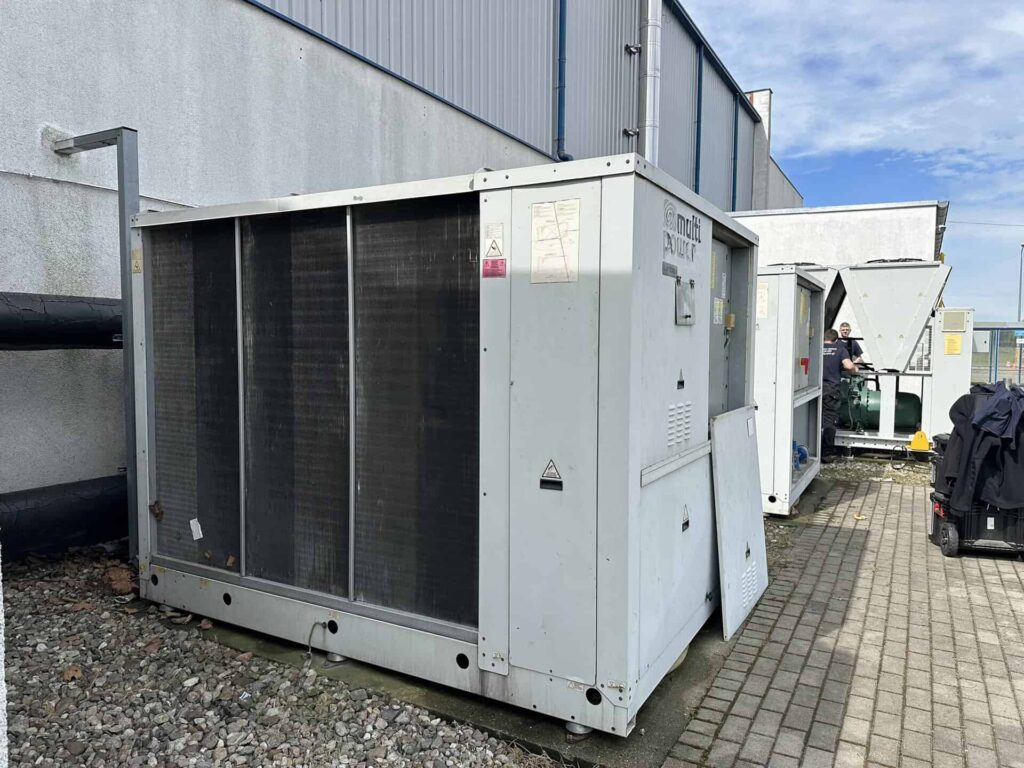
Where an existing chiller is being replaced, we measure the real load: flow and temperature difference on the water side, logged over a representative period. The nominal capacity of the old unit is often a poor guide, because it was either oversized at the start or the process has changed since. For new processes we work from the heat input of the machines (for example motor and hydraulic losses, mould cooling loads) and the required temperature stability.
Hydraulics
The chiller is only one part of the system. We check pump capacity, pipe sizes, buffer tank volume and the condition of strainers and valves. A small system volume causes short compressor cycles even with a correctly sized unit, so we often recommend a buffer tank. Installations are covered on the chilled water installations page.
New or refurbished
A refurbished unit can be a sound choice for a limited budget, a temporary production line or a backup. A new unit makes sense where efficiency, low GWP refrigerant and a long service life matter most. We compare both options on the same basis:
- Capacity at your temperatures and ambient.
- Refrigerant and its regulatory outlook.
- Condition of compressors, heat exchangers and electrics (for refurbished units, checked and documented).
- Expected energy consumption at part load.
- Availability of spare parts.
Installation and start-up
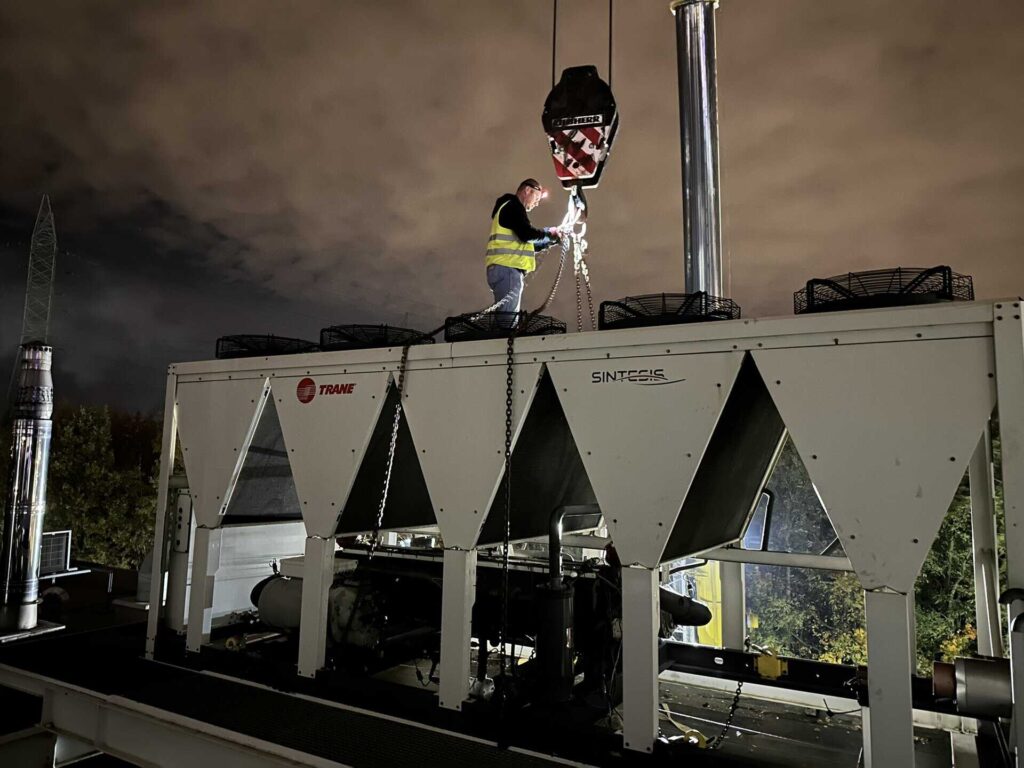
SKiC teams make the hydraulic connections in steel, stainless steel or press fittings, connect power and controls, fill and vent the system, and start the unit. Start-up includes a pressure and leak check, setting of controls and safety devices, and a record of readings under load. The start-up report becomes the reference for all later service visits. If the unit needs to be integrated with a building management system or monitored remotely, we add web visualisation and alarms, see controls and remote monitoring.
Service after supply
After start-up the unit can be included in a planned maintenance contract with leak checks at the interval required for its charge. Because we selected and installed it, we know its history from day one. If you need cooling before the new unit arrives, ChillerTech also provides chiller rental.
Questions from maintenance teams
Can you select a chiller without a site visit?
A preliminary selection is possible from data you send us. For a final selection we prefer to see the site and measure the existing load.
Which refrigerant should we choose?
It depends on capacity, location and safety requirements. Low GWP refrigerants reduce regulatory risk; R290 requires attention to flammability zones.
Is free cooling worth it?
For processes running all year with return temperatures above roughly 12 to 15 °C it usually is. We estimate the hours based on your temperatures and climate.
Who services the unit after supply?
SKiC, under a planned maintenance contract or on call-out.
Can you remove the old unit?
Yes, including recovery of the refrigerant by certified personnel.
Planning a new or replacement chiller?
Send us your temperatures, capacity needs and site details, and we will prepare a selection with ChillerTech.