
Data centre and server room cooling
Server rooms and data centres need cooling that never becomes the reason for an outage. SKiC services precision air conditioning, chillers and free cooling, and builds the redundancy and alarms that make a single failure a non-event.
F-gas company certificate. A report with measurements after every visit. Mobile service in Poland and the EU.
What IT equipment actually needs
The reference for most operators is the ASHRAE thermal guideline for data processing environments. Its recommended envelope for the air at the server inlet is 18 to 27 °C, with humidity between a dew point of minus 9 °C and plus 15 °C and an upper limit of 60 to 70 percent relative humidity depending on the edition and on the level of airborne pollutants. Many rooms are still run at 20 to 22 °C supply because that was the habit, which costs energy and shortens the free cooling season without any benefit to the servers.
The heat load is almost entirely sensible. A typical rack draws 3 to 10 kW, high density racks 20 kW and more. Every kW of IT power becomes a kW of heat that must be removed continuously, 8,760 hours a year.
Air management
Before adding cooling capacity, we look at where the cold air goes. Missing blanking panels, open cable cut-outs in a raised floor and racks placed without hot and cold aisles let cold air bypass the servers and hot air recirculate. Containment of the cold or hot aisle often allows the supply temperature to rise by several kelvin.
Cooling equipment in server rooms and data centres
| System | Typical use | Typical temperatures |
|---|---|---|
| Precision unit with DX circuit (CRAC) | Server rooms up to a few hundred kW | Return air 24 to 35 °C, supply 18 to 24 °C |
| Precision unit on chilled water (CRAH) | Larger rooms with a central chiller plant | Chilled water 10/16 °C to 18/24 °C |
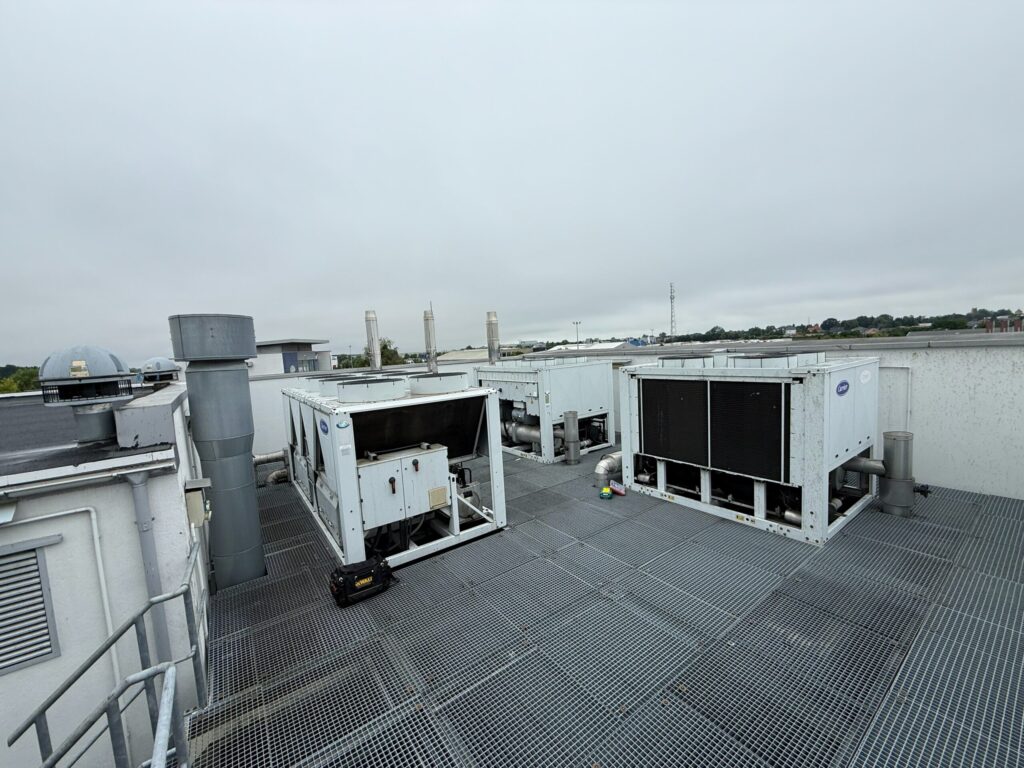
| Chiller with free cooling | Central plant for CRAH units and in-row coolers | Free cooling below roughly 10 to 15 °C ambient |
| Dry coolers | Free cooling and heat rejection for water-cooled units | Glycol 30 to 35 percent |
| In-row and rear door coolers | High density racks | Chilled water 15 to 20 °C |
Higher chilled water temperatures extend free cooling dramatically. A plant running at 16/22 °C can cover most of the year in Central Europe without compressors, while a plant at 7/12 °C uses its compressors almost all year.
Redundancy and restart behaviour
- N+1 precision units, so that any one unit can be stopped for service without the room temperature rising.
- N+1 chillers and pumps, with automatic changeover and rotation of duty.
- Cooling for critical rooms on a generator or UPS, at least the fans and pumps, so the air keeps moving during a chiller restart.
- Fast restart settings on chillers; a standard restart after power return can take 3 to 5 minutes, which a dense room cannot always ride through.
- A chilled water storage tank that covers the restart time.
- Independent temperature sensors at the rack inlets, with alarms by SMS or e-mail, see controls and remote monitoring.
SKiC does not run a 24/7 emergency standby. We design and maintain the cooling so that a failure of one unit is covered by redundancy and can be repaired during working hours.
Typical failures
- Low pressure trips of DX units in winter because the condenser fan speed control does not hold the condensing pressure.
- Humidifier cylinders scaled up, electrodes worn, or humidifiers fighting with dehumidification in neighbouring units.
- EC fan failures and clogged filters reducing airflow without a clear alarm.
- Condensate pumps failing and water reaching the raised floor.
- Refrigerant leaks on vibrating lines, slowly reducing capacity until the first hot day.
- Dry coolers frozen or overheated: insufficient glycol, fouled coils, failed fans.
- Sensors out of calibration, so units work against each other.
How SKiC services data centre cooling
Inspections with measurements
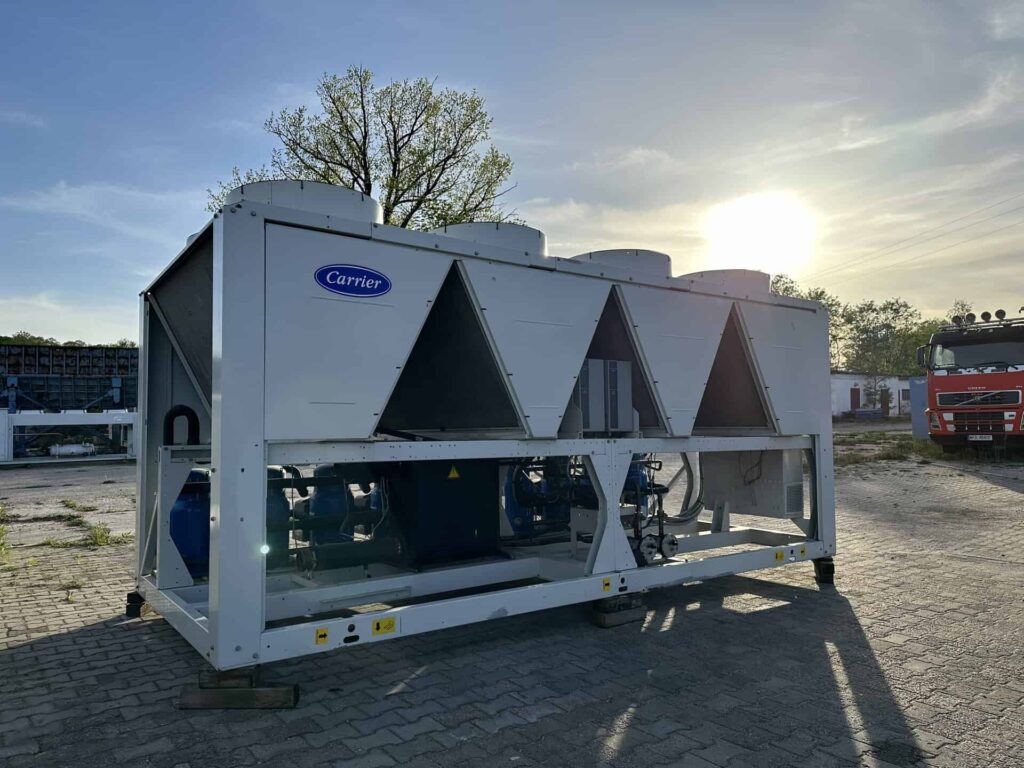
At each visit we record supply and return air temperatures, humidity, refrigerant pressures, superheat and subcooling, compressor and fan currents, filter pressure drop, chilled water temperatures and the state of humidifiers and condensate drains. We compare unit sensors with a reference instrument and check that alarms reach the right people. See precision air conditioning repair.
Modernisation
Typical projects are raising setpoints after containment, adding free cooling to an existing chiller plant, replacing fans with EC fans, adding a storage tank, and building unit sequencing and alarms on a Siemens PLC with web visualisation. For the heat rejection side see dry cooler service.
F-gas compliance
A precision unit with 12 kg of R410A has 25.1 t CO2 eq. and needs a leak check every 12 months, or every 24 months with a leak detection system. We carry out the checks and update the records under Regulation (EU) 2024/573.
Questions from maintenance teams
Can we raise the room temperature safely?
Usually yes, if the server inlet temperature stays within 18 to 27 °C and hot spots are eliminated first. We measure the inlet temperatures at several heights before and after the change.
How many inspections per year do precision units need?
We recommend quarterly checks of filters, humidifiers and drains, and two full inspections a year with measurements, one before summer and one before winter.
Our units alarm on low pressure in winter. Why?
The condensing pressure falls too low at low ambient temperature. Fan speed control, its sensor or the setting is usually at fault, sometimes refrigerant undercharge.
Can free cooling be added to an existing chiller?
Often yes, with a separate dry cooler and a three-way valve before the chiller, provided the system runs on glycol or a heat exchanger separates the outdoor circuit.
Take cooling off your risk list
Send us your room layout, the unit list and the alarm history, and we will propose an inspection and a redundancy review.