
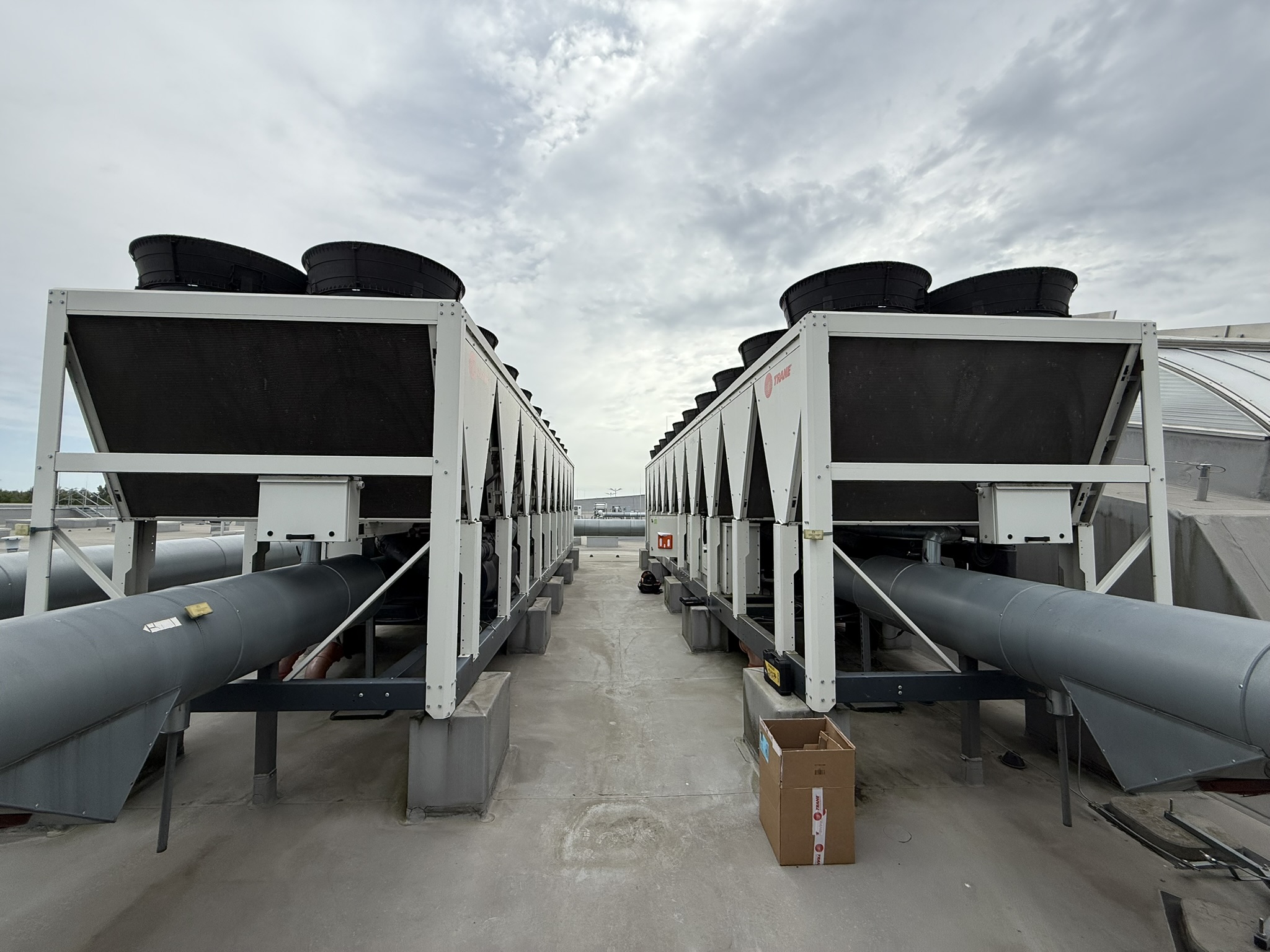
Injection moulding cooling
In injection moulding, cooling time is often the largest part of the cycle and the mould temperature decides part quality. SKiC services the chillers, free cooling and water circuits that cool moulds and hydraulic oil.
F-gas company certificate. A report with measurements after every visit. Mobile service in Poland and the EU.
Cooling needs of an injection moulding shop
A moulding machine needs heat removed in three places. The mould, where the melt solidifies; the hydraulic oil, heated by pumps and valves; and the feed throat of the barrel, which must stay cool so the granulate does not bridge. Each circuit has a different temperature, so a well designed plant runs at least two water circuits.
| Circuit | Typical temperature | Source of cooling |
|---|---|---|
| Mould cooling, cold | 8 to 15 °C supply | Process chiller |
| Mould temperature control units | 40 to 90 °C water, higher with oil | Temperature control unit, cooled by the plant water |
| Hydraulic oil | 40 to 50 °C oil | Oil to water heat exchanger on the tempered circuit, 25 to 30 °C |
| Feed throat | 25 to 35 °C | Tempered circuit |
| Robots, dryers, granulators | 15 to 30 °C | Tempered or cold circuit |
The cooling capacity is driven by throughput: as a rough guide, cooling a polyolefin from melt to demoulding temperature takes 0.15 to 0.2 kWh of heat removal per kg of material in the mould alone, plus the hydraulic losses, which on older hydraulic machines can match the mould load.
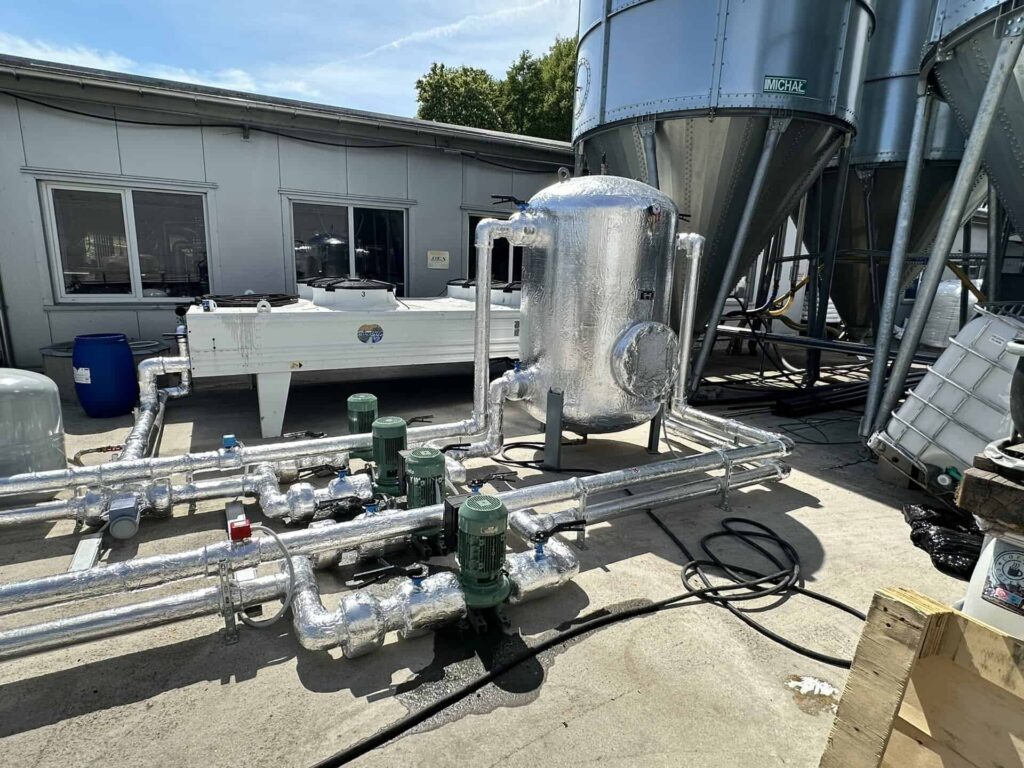
Two circuits and free cooling
Running the hydraulic oil and feed throat on chilled water at 10 °C wastes energy. These consumers are happy with water at 25 to 30 °C, which a dry cooler can supply without a compressor for most of the year in Central Europe. Even the cold mould circuit can be partly free cooled: with a dry cooler approach of about 5 K, a 15 °C supply is fully free cooled below roughly 10 °C ambient and partly below 13 °C. A chiller with an integrated or external free cooling coil and a three-way valve makes this automatic.
The outdoor circuit must be filled with glycol, typically 25 to 35 percent, and separated from the machines by a plate heat exchanger if the machines cannot tolerate glycol. More on dry cooler service.
Water quality and condensation
Water treatment
Mould cooling channels are typically 6 to 12 mm in diameter, and scale or corrosion products of a fraction of a millimetre reduce heat transfer noticeably. A closed circuit should be filled with softened or demineralised water, dosed with a corrosion inhibitor and filtered, usually with 100 to 200 µm strainers or a side stream filter. We check pH, conductivity and visible contamination, and recommend flushing when the pressure drop across the moulds rises.
Condensation on the mould
At 25 °C hall temperature and 60 percent relative humidity, the dew point is about 17 °C. A mould cooled with 8 °C water will sweat, and the water causes surface defects and corrosion of the cavity. The options are a higher water temperature in summer, dehumidifying the air around the mould, or controlling the supply temperature based on the measured dew point. We set up the latter in the chiller or plant controller where it makes sense.
Typical failures and their effect
- Chiller high pressure trips in summer, because the condenser is clogged with granulate dust and fibres. Cycle times are increased by the operators and output drops.
- Rising cooling water temperature from insufficient capacity after new machines were added without upgrading the plant.
- Blocked mould channels and quick couplings, leading to hot spots, warpage and sink marks.
- Leaking oil to water heat exchangers, contaminating the cooling water with hydraulic oil.
- Pump failures without standby, which stop the whole moulding shop at once.
- Frozen dry cooler coils after a winter with too little glycol in the circuit.
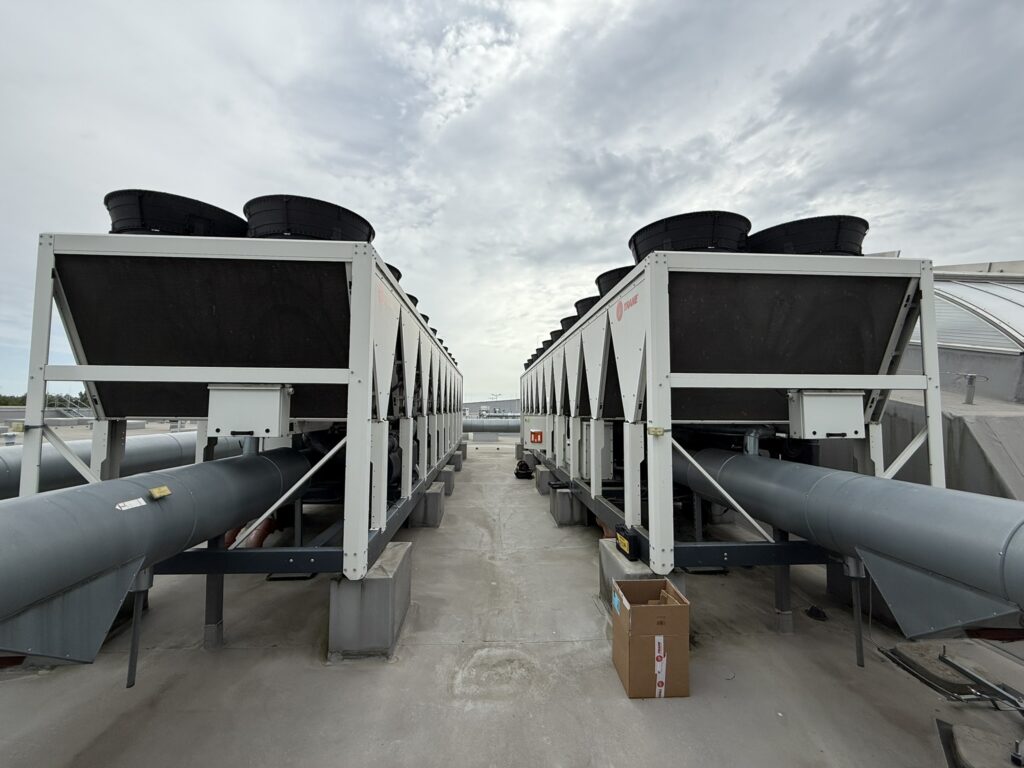
How SKiC services and modernises moulding plants
- Diagnostics with measurements: refrigerant circuit, water temperatures and flows per circuit, pump curves and pressure drops, glycol concentration and water quality.
- A report with the actual cooling load compared with the installed capacity, and where the losses are.
- Repairs of chillers, dry coolers, pumps and heat exchangers, on site or in the Wałsnów workshop.
- Modernisation: separating the circuits, adding free cooling, inverter pumps controlled on pressure difference, buffer tanks and filtration.
- Controls on Siemens PLC with HMI and alarms by SMS or e-mail, so a stopped chiller is known before the first rejected part.
Details of process chiller work are on process cooling and chiller service and repair.
Questions from maintenance teams
Can we raise the mould water temperature to save energy?
Only after checking with the process engineers, because it changes cooling time and part properties. The hydraulic oil and feed throat circuits, however, can almost always run warmer and on free cooling.
How often should the circuit be flushed?
It depends on water quality. With treated water and filtration, checks of pH, conductivity and pressure drop once or twice a year are usually enough. Without treatment, scaling can block channels within a year.
Our chiller struggles only in July and August. Do we need a bigger one?
Not necessarily. A cleaned condenser, correct refrigerant charge and moving the hydraulic oil load to a dry cooler often restore enough reserve. We measure first and then recommend.
Is glycol harmful to the moulds?
Inhibited glycol is not corrosive, but it lowers heat transfer and some machine builders do not allow it. A plate heat exchanger between the outdoor glycol circuit and the machine water solves this.
Can you check the temperature control units too?
We check how they are supplied with cooling water and whether their cooling valves work. Heater and pump repairs inside the units are assessed case by case.
Shorten cycle times with reliable cooling
Send us the list of machines, the chiller data and your temperature setpoints, and we will propose diagnostics and a plan for the plant.