
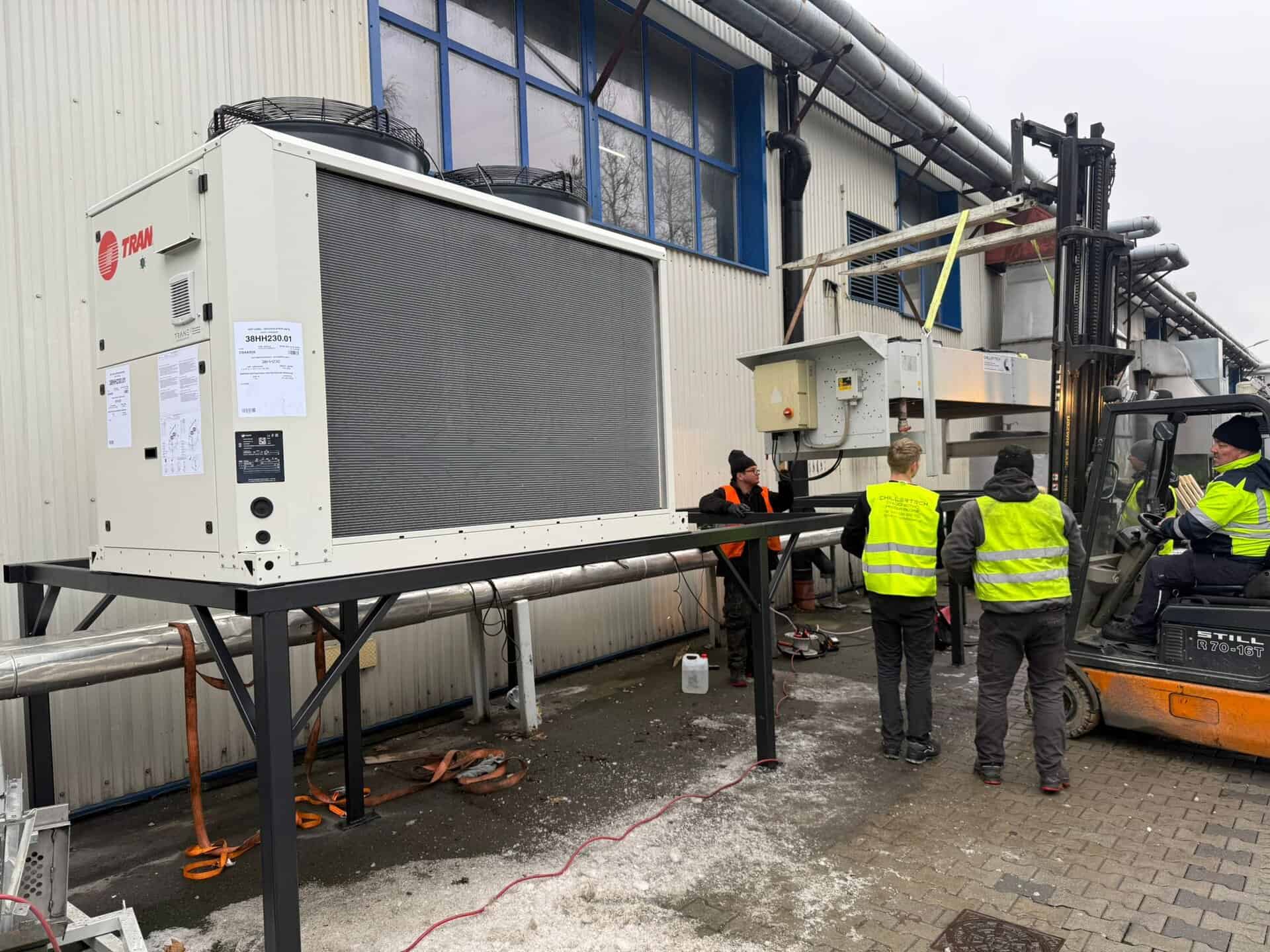
Refrigerated container service
Refrigerated container service for units such as Carrier 69NT40 that are used as stationary cold stores at plants, warehouses and building sites. We diagnose the refrigeration unit and controller, check for leaks and repair on site.
F-gas company certificate. A report with measurements after every visit. Mobile service in Poland and the EU.
Containers as cold stores
A reefer container is a quick and flexible way to add cold storage: for seasonal peaks, during the refurbishment of a cold room, or as permanent storage on sites without a building. The refrigeration unit, however, is designed for transport. On a ship or a terminal it receives product already cooled to the setpoint and only maintains the temperature. As a stationary store it is often loaded with warm goods, opened many times a day, placed in full sun and connected to a long temporary cable. These conditions cause most of the faults we see during refrigerated container service.
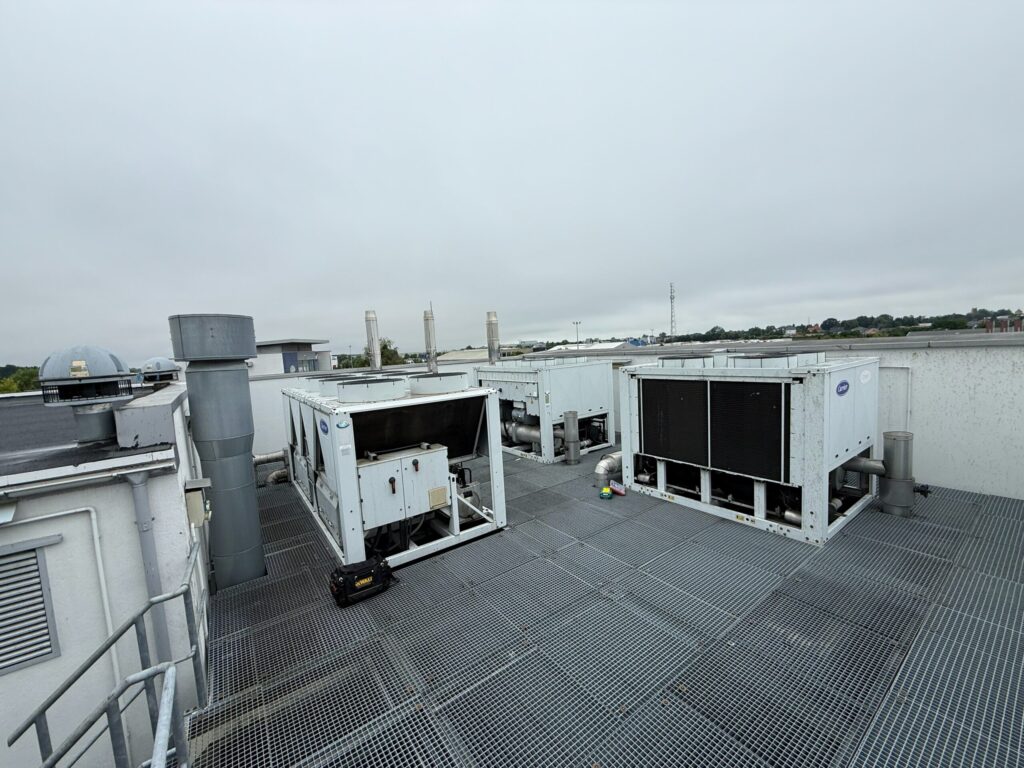
The refrigeration unit
The Carrier 69NT40 family is one of the most common reefer units in Europe. Most units run on R134a, while the NaturaLINE versions use R744 (CO2). The unit combines a compressor, an air-cooled condenser with fan, an evaporator with fans behind the front panel, electric defrost heaters, expansion and capacity control valves and a microprocessor controller with a data recorder. It works in chilled mode with return air control or in frozen mode with supply air control, depending on the setpoint.
We are not affiliated with Carrier or any container manufacturer; we service these units independently after the warranty, in the same way as other refrigeration equipment.
Diagnostics
- Readout of the active and stored alarms and of the temperature log from the data recorder.
- Pressures, superheat and compressor current under load, in the operating mode the store uses.
- Supply and return air temperatures compared with the controller sensors.
- Check of the power supply: voltage at the plug under load, phase sequence, cable cross-section and plug condition.
- Condenser coil condition and air flow, evaporator coil and drain lines.
- Door seals, drain plugs and the floor channels that guide air under the load.
Common faults in stationary use
| Symptom | Typical cause | Remedy |
|---|---|---|
| Temperature not reached after loading | Warm product loaded, unit designed for maintaining temperature | Precool goods, load in stages, check capacity against the actual heat load |
| High pressure alarms in summer | Container in the sun, condenser blocked or close to a wall, dirty coil | Clean coil, keep free space at the condenser, shade the unit |
| Compressor or phase alarms | Voltage drop on a long cable, loose plug, wrong phase sequence | Measure voltage at start, correct the supply |
| Ice on the evaporator, poor air flow | Frequent door openings, failed defrost heater or termination sensor | Repair defrost, use strip curtains, limit door openings |
| Water on the floor or ice in the drain | Blocked drain hoses, drain heater in frozen mode | Clear the drains, check heaters |
| Sensor alarms | Damaged probe cable or connector after handling | Replace the probe, verify against a reference thermometer |
Loading pattern matters in a stationary store. The air is blown under the floor through T-shaped channels and returns over the top of the load. Pallets placed directly against the front bulkhead, goods stacked above the red load line or cartons covering the floor channels block the air circulation and create warm zones even when the controller shows the setpoint.
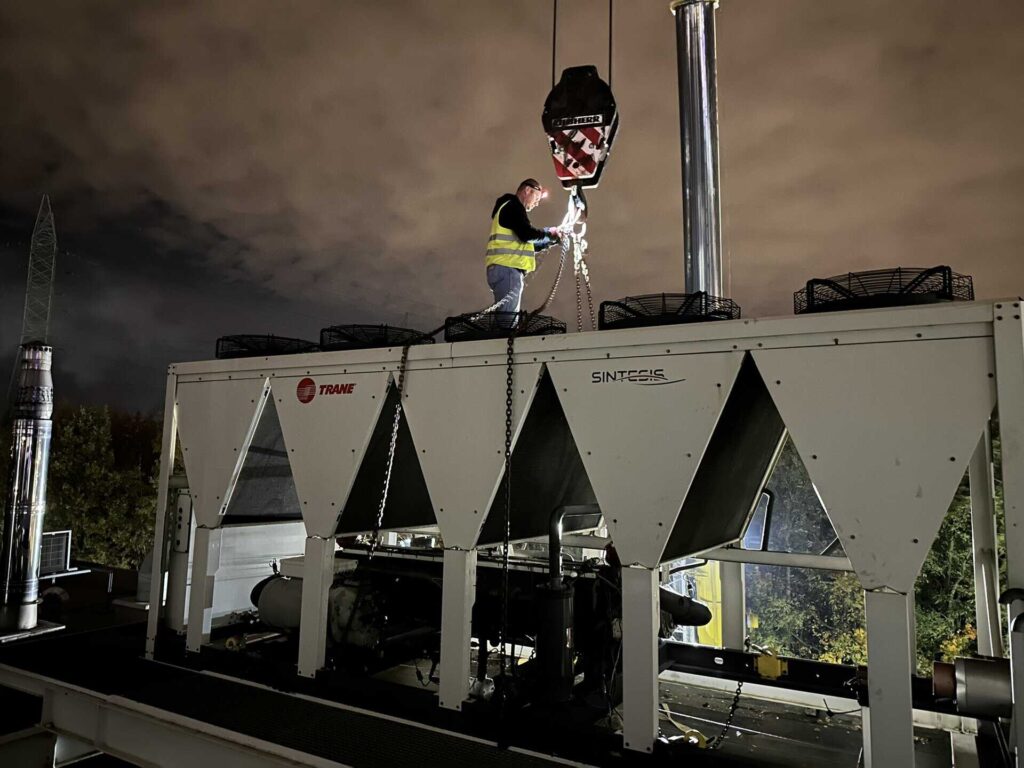
Power supply on site
Container units are built for 380 to 460 V three-phase supply and draw a high starting current. On sites the container is often fed through a long extension cable from a distant panel. We measure the voltage at the plug when the compressor starts; a drop of more than about 10 percent leads to failed starts, contactor chatter and overheated compressor windings. A dedicated feeder with correct protection and cable cross-section is a cheap fix compared with a compressor replacement.
Leak checks and records
A typical R134a charge in a container unit is a few kilograms. With 5 kg of R134a (GWP 1430) the unit holds 7.15 t CO2 eq., which means a leak check every 12 months under Regulation (EU) 2024/573 when the container is used as a stationary refrigeration system. We perform the check, make the entries in the equipment records and repair leaks by brazing, followed by evacuation and charging by weight.
Repairs
On site we replace compressors, fan motors, contactors, defrost heaters, sensors, expansion and solenoid valves and controller modules. We also repair damaged coils and pipework after transport and handling. Before a container is put into service as a store, we recommend a commissioning check: leak test, pressure readings, defrost test and verification of the sensors.
For permanent cold storage, a cold room with a condensing unit is often more economical than a container; see condensing unit service. Temperature alarms by SMS or e-mail can be added through our controls and remote monitoring work, and the containers can be included in a planned maintenance schedule.
Questions from maintenance teams
Can a container hold frozen goods at -25 °C?
Most units can reach typical frozen setpoints, but only if the goods are loaded frozen. Freezing warm product inside a container is slow and overloads the unit.
How often should a stationary container be serviced?
We recommend an inspection at least once a year and a condenser clean before summer, plus the leak check interval required by the charge.
Can you download the temperature records?
Yes, we read the stored temperature data from the controller and include it in the report if you need it for quality documentation.
Do you service other container units than Carrier?
Yes, other makes of reefer units can be serviced as well. Send the model and serial number with the enquiry.
Container cold store not holding temperature?
Send the unit model, the alarm codes and a photo of the installation, and we will plan the visit.