
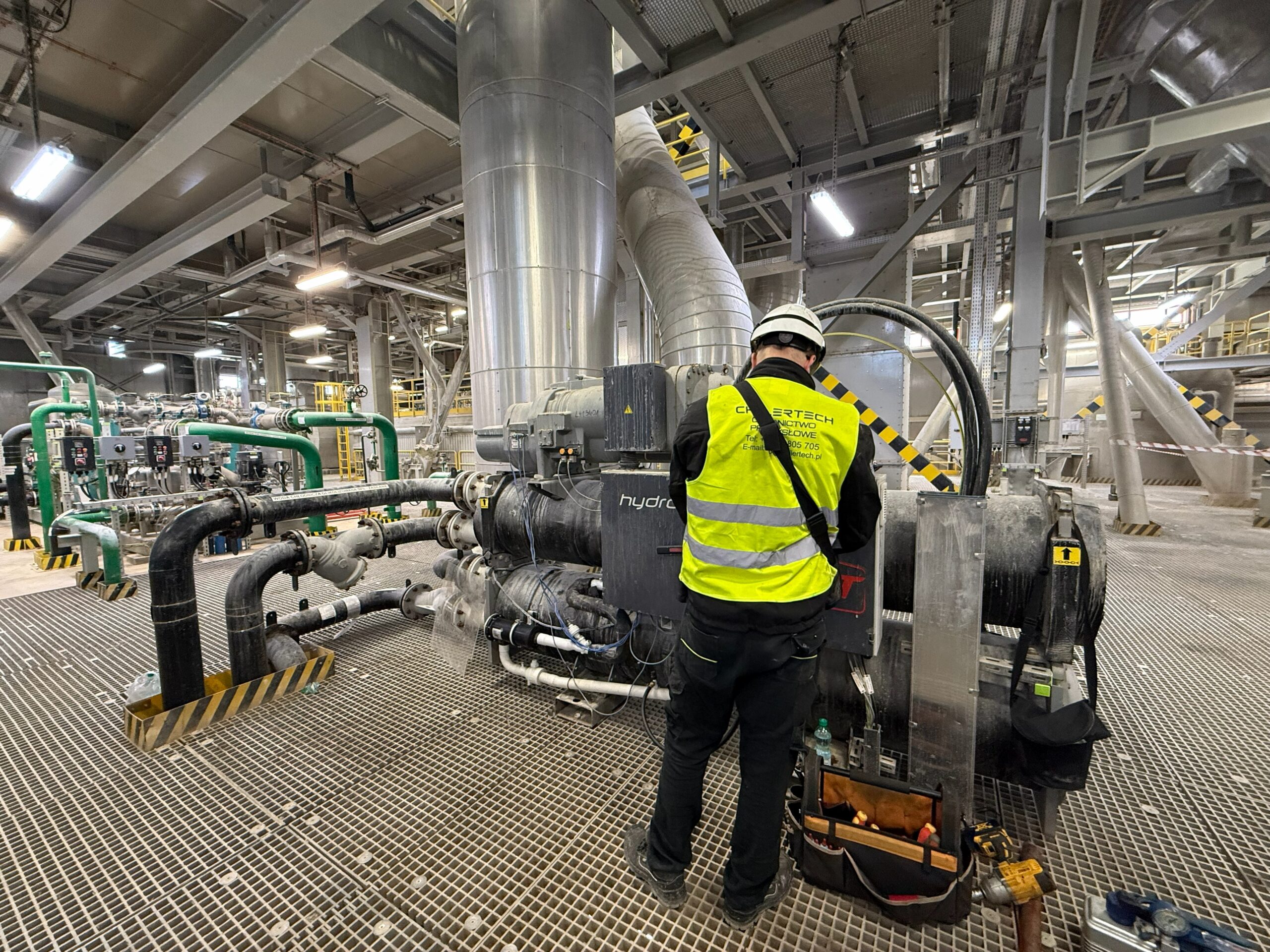
Industrial heat pump service
Industrial heat pump service for air-to-water and water-to-water units in plants and commercial buildings. We diagnose the refrigerant circuit, defrost, water side and controls, and measure the actual efficiency.
F-gas company certificate. A report with measurements after every visit. Mobile service in Poland and the EU.
Heat pumps in industry and large buildings
Large heat pumps heat production halls, offices and warehouses, preheat process water or recover heat from cooling circuits. Many work in reversible mode and provide cooling in summer. Unlike a chiller, a heat pump works hardest in the coldest weather, at the highest compression ratio and with defrost cycles in between. Faults therefore cluster in winter, when a stopped unit means a cold building or a process without heat. Industrial heat pump service has to address the refrigerant circuit, the defrost and the water system together, because each can trip the unit.
Refrigerant circuit
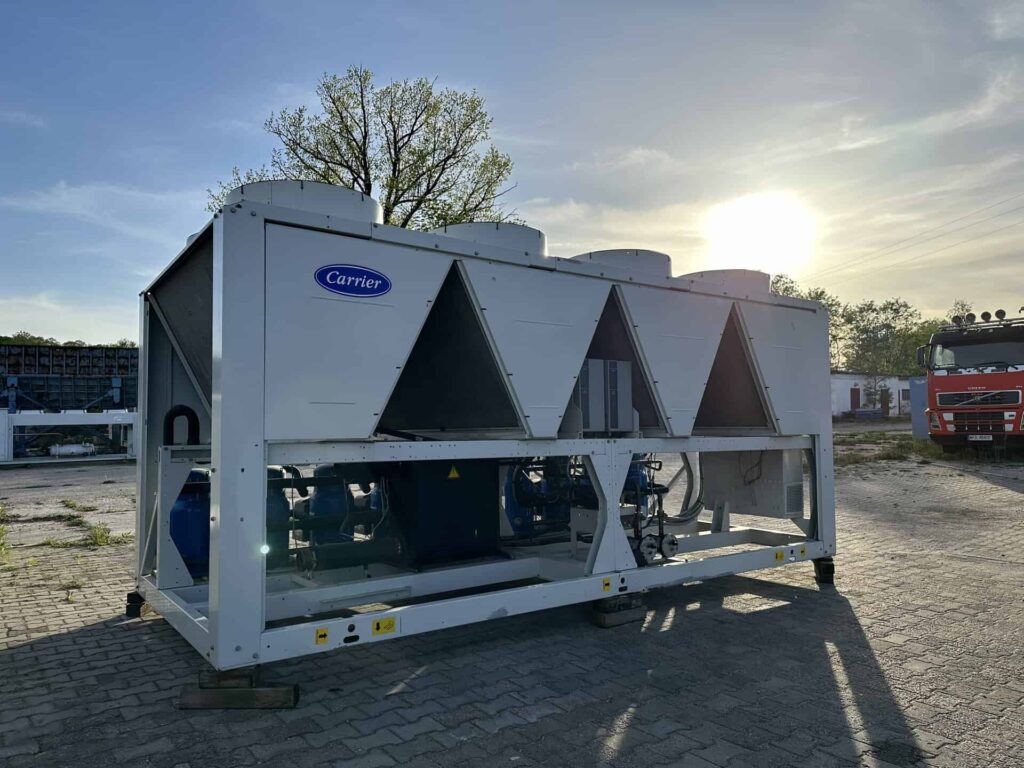
Common refrigerants in the units we service are R410A (GWP 2088), R32 (GWP 675), R134a (GWP 1430) in higher temperature applications and, in newer units, R290 (GWP 3). We measure pressures, superheat, subcooling, discharge temperature and compressor currents in heating mode under real conditions.
Discharge temperature is the critical value in heat pumps. At low outdoor temperatures and high flow temperatures the compression ratio rises and the discharge temperature can approach the compressor limit. Units with vapour injection or economisers depend on the injection valve working correctly; a stuck valve causes high discharge temperature trips on cold nights.
Four-way valve
In reversible units the four-way valve switches between heating, cooling and defrost. A valve that does not shift completely leaks hot gas to the suction side, which shows as low efficiency, a warm suction line and a high discharge temperature. We measure temperatures at all four ports to confirm it.
Defrost
Air-to-water heat pumps ice up their outdoor coils at outdoor temperatures between roughly -5 and +5 °C with high humidity. Defrost is usually done by reversing the cycle for a few minutes. Problems we see regularly:
- Defrost starting too often, because of a faulty coil temperature sensor or wrong parameters, with heating capacity lost each time.
- Defrost terminated too early, leaving ice in the lower part of the coil that grows with every cycle.
- Melt water freezing in the base tray because the tray heater has failed or the drain is blocked.
- Unit installed too close to the ground, in a place where snow drifts block the coil.
- Water flow too low during defrost, so the plate heat exchanger cools down dangerously.
Water side
The plate heat exchanger of a heat pump is small and sensitive to flow. Low flow trips the unit on high pressure in heating mode and can freeze the exchanger in defrost or cooling mode. We check the design temperature difference (often 5 K), measure flow and pressure drop, clean the strainers and check the expansion vessel and system pressure.
| Symptom | Water side cause | Refrigerant side cause |
|---|---|---|
| High pressure trip in heating | Low flow, closed valve, blocked strainer, air | Overcharge, non-condensables |
| Low pressure trip | Source water too cold or low flow (water-to-water) | Leak, iced coil, expansion valve fault |
| Low heating capacity | Fouled plate exchanger, wrong buffer connection | Defrost problems, four-way valve leaking |
| Frequent start and stop | Small water volume, no buffer tank | Wrong controller hysteresis |
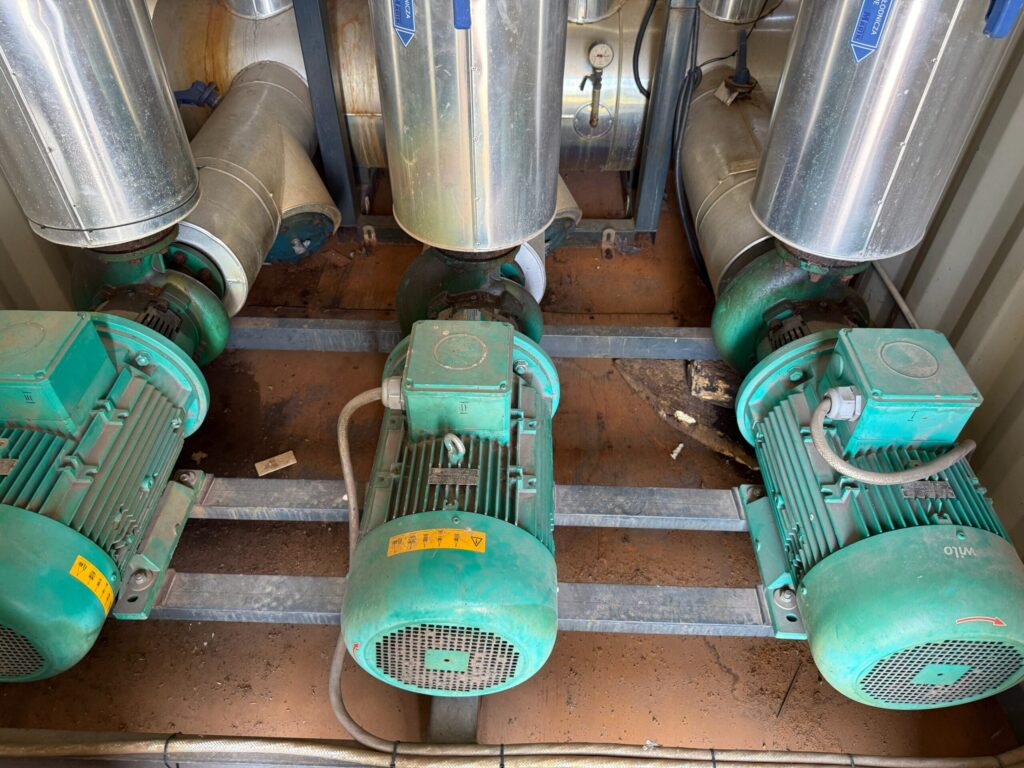
Pumps on the heating circuit are serviced and regenerated by our team as well; see pump repair.
Efficiency measurement
We estimate the actual coefficient of performance from the measured heating output (flow multiplied by temperature difference) and the electrical input. Every kelvin of lower flow temperature typically improves the COP by around 2 to 3 percent, so a heating curve that is set higher than the building needs is a common and cheap fix. Where heat pumps serve air handling units, the supply water temperature needed by the coils decides how low the curve can go; see air handling unit service.
Controls
Heat pumps in commercial buildings are often cascaded with boilers. Wrong priorities or bivalent points can leave the heat pump idle while the boiler runs. We check the sequence, sensor positions and setpoints, and integrate the units into central monitoring with remote alarms through our controls team.
Pre-season inspection checklist
- Leak check and records according to the charge in t CO2 equivalent.
- Cleaning of the outdoor coil and check of the base tray, tray heater and drain.
- Measurement of pressures, superheat, subcooling and discharge temperature in heating mode.
- Forced defrost test with observation of the four-way valve and the defrost termination.
- Water flow, temperature difference, strainers, system pressure and expansion vessel.
- Electrical checks: terminals, contactors, compressor currents and insulation resistance.
- Review of the heating curve, setpoints and alarm history.
Questions from maintenance teams
Why does our heat pump trip only on very cold nights?
Usually because of high discharge temperature, defrost problems or low water flow. The alarm history and a measurement during cold weather normally show which one.
How often should a heat pump be inspected?
Before the heating season and before the cooling season for reversible units, plus the leak checks required by the charge in CO2 equivalent.
Do propane heat pumps need special handling?
Yes. Work on R290 units requires flammable refrigerant procedures, gas detection and suitable tools, and we apply them on every visit.
Can a heat pump be added to an existing boiler system?
Yes, but the flow temperatures, hydraulic connection and control priorities must be checked first, otherwise the heat pump runs at poor efficiency.
Heat pump not delivering heat?
Send the model, the alarm history and the flow temperature setting, and we will plan a diagnostic visit.