
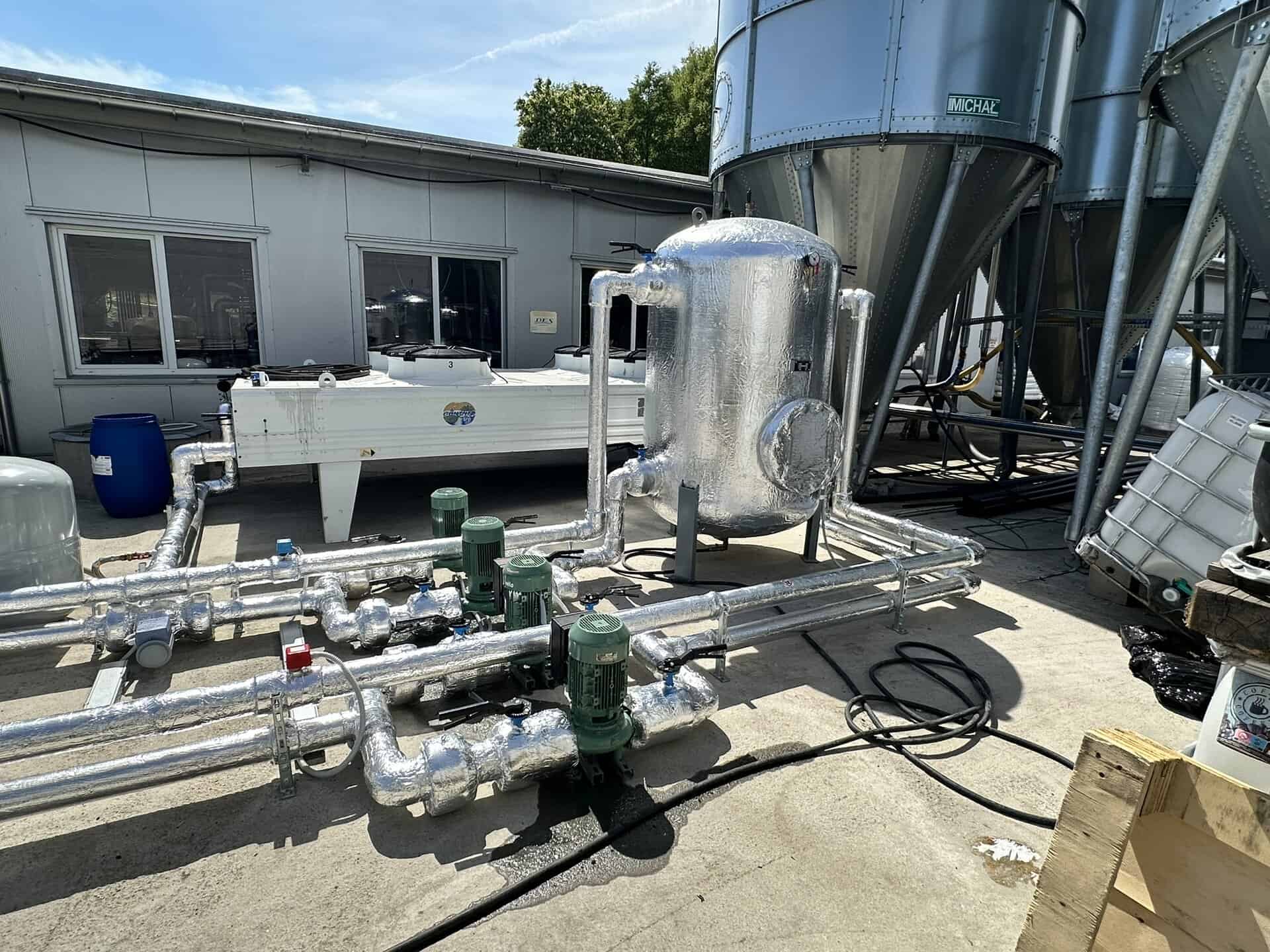
Dry cooler service
Dry cooler service: coil cleaning and repair, fan and EC controller replacement, free cooling settings and frost protection. We keep the approach temperature low so that the chiller and the process do not pay for a fouled coil.
F-gas company certificate. A report with measurements after every visit. Mobile service in Poland and the EU.
How a dry cooler loses capacity
A dry cooler rejects heat from a water and glycol circuit to the outdoor air through a finned coil and fans. It has no refrigerant circuit, so faults show up slowly: the leaving fluid temperature creeps up, the chiller condenses at a higher pressure or free cooling switches over later in the season. The key value for dry cooler service is the approach, the difference between the leaving fluid and the outdoor air. A clean unit at full fan speed typically reaches 4 to 8 K, depending on its selection. When the approach grows to 12 K or more under similar conditions, something is wrong.
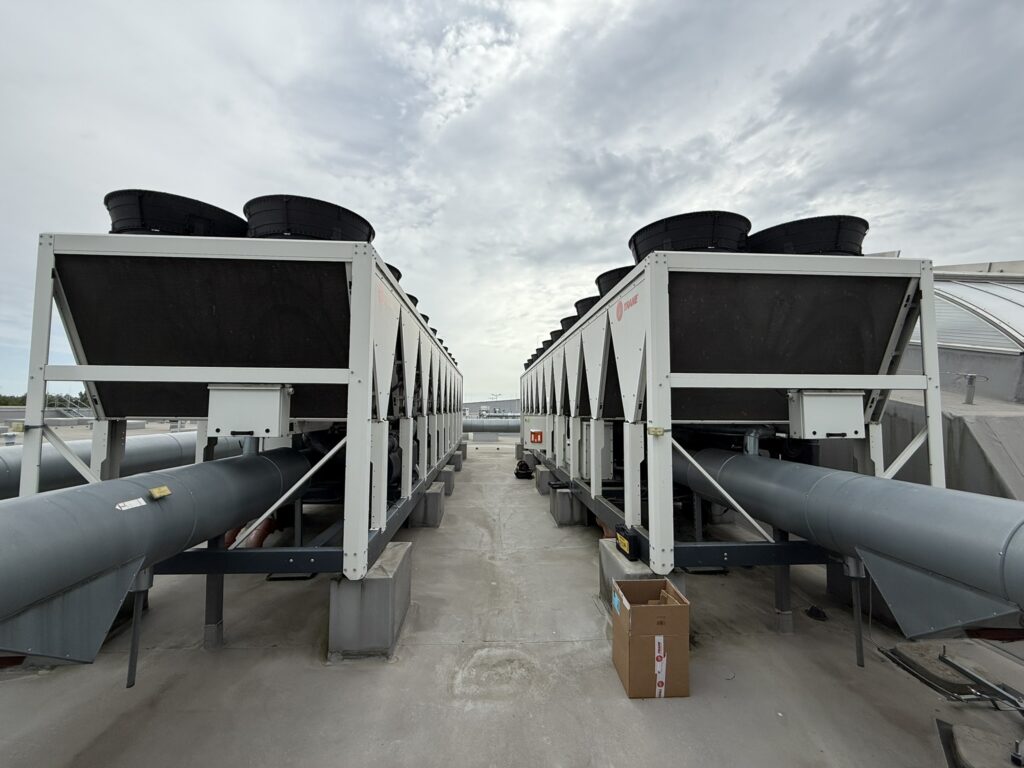
Coil cleaning and repair
Fouling
Poplar fluff, pollen, dust from nearby production and leaves build a felt on the air inlet side of the coil. In V-shaped units the inner surfaces are often worse than the visible ones. We clean against the direction of the air flow with low-pressure water and, where needed, a coil cleaner suitable for aluminium fins. High-pressure jets bend the fins and reduce the air flow even more, so we avoid them. Bent areas are straightened with a fin comb.
Leaks
Glycol leaks appear at copper return bends, at headers and where tubes rub on support plates. Typical causes are vibration, galvanic corrosion in coastal or industrial air, and frost damage when the glycol concentration was too low. Small leaks are repaired by brazing on site. Where single tubes inside the coil are damaged, the circuit can be plugged at both ends; up to roughly 5 to 10 percent of the tubes can be plugged before the capacity loss becomes noticeable. Beyond that, a new coil or a new dry cooler is the better choice.
Fans and EC controllers
Most modern dry coolers use EC fans controlled by a 0 to 10 V signal or over Modbus. We check bearing noise, current draw, fan blade condition and the alarms stored in the fan electronics. Failed EC motors are replaced as complete units with the same air performance, and the Modbus address and parameters are set so that the controller sees the new fan. On older AC units we check the speed controllers and the motor windings, and often propose a change to EC fans, which reduces power consumption at part load considerably.
Free cooling settings
When the dry cooler works in free cooling mode with a chiller, the changeover logic decides how many hours per year the compressors can stay off. Common errors we find:
- Changeover threshold set to a fixed outdoor temperature instead of comparing the outdoor air with the return water.
- Three-way valve that does not close fully, so warm water bypasses the coil or cold fluid enters the chiller condenser circuit.
- Hysteresis too narrow, causing frequent switching between modes.
- Fans limited to a low maximum speed for noise reasons, which was never revised.
Frost protection
The freezing point of the glycol mixture must be lower than the lowest outdoor temperature on site, with a margin. We measure the concentration with a refractometer and compare it with the design value.
| Ethylene glycol, percent by volume | Approximate freezing point |
|---|---|
| 20 | -8 °C |
| 30 | -15 °C |
| 35 | -20 °C |
| 40 | -24 °C |
Propylene glycol needs a somewhat higher concentration for the same protection. Topping up a leaking system with water dilutes the mixture year by year, which is why frost-burst coils are often found after the first hard winter following a leak repair. We also check the inhibitor condition, because degraded glycol becomes acidic and attacks copper and steel.
Typical findings
| Symptom | Likely cause |
|---|---|
| Chiller high pressure alarms on hot days | Fouled coil, fans not reaching full speed, recirculation of warm air |
| Free cooling active only a few weeks per year | Wrong changeover logic or leaking three-way valve |
| Falling system pressure | Glycol leak at bends or headers |
| One fan section warmer than the others | Failed fan or blocked part of the coil |
Dry coolers are part of the hydraulic system as a whole. Their selection in new plants is covered on the refrigeration system design page, and the chillers they serve on our chiller service page. Complete glycol circuits are described under process cooling.
Questions from maintenance teams
How often should a dry cooler be cleaned?
At least once a year, before summer. Sites near trees or dusty production often need a second clean after the poplar season in early summer.
Can a leaking coil be repaired without draining the whole system?
Often yes, if the dry cooler has isolation valves. The section is isolated, drained, repaired and refilled with a mixture of the correct concentration.
Is it worth replacing AC fans with EC fans?
Usually yes when the unit runs at part load for many hours. The payback depends on the operating profile, which we estimate before quoting.
Do you supply glycol?
Yes, we supply and mix inhibited ethylene or propylene glycol and dispose of the old fluid.
Is your dry cooler running hot?
Send photos of the coil and the fan section, and we will propose cleaning, repair or replacement with a cost estimate.