
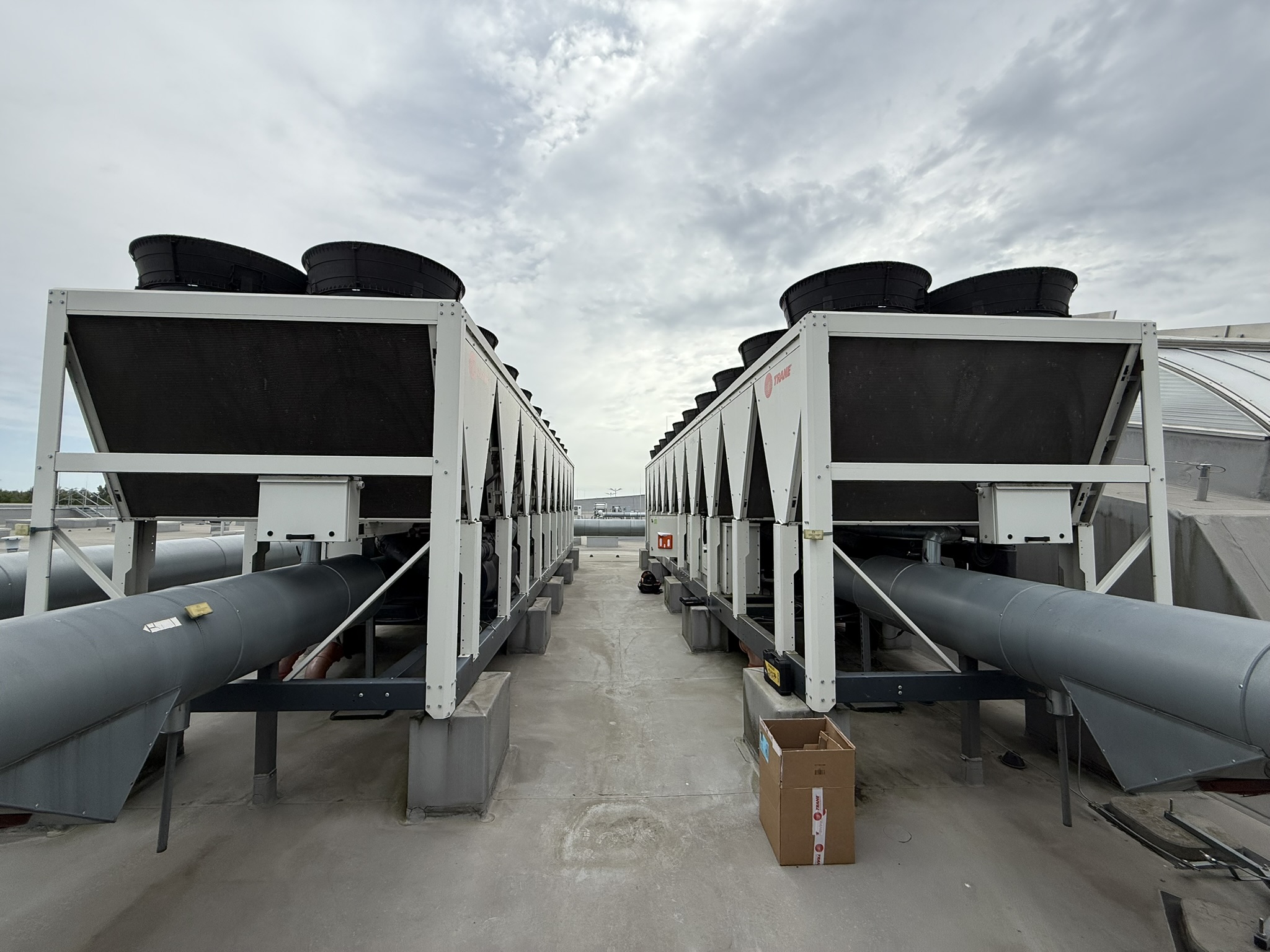
Industrial coolers
Service and repair of industrial coolers for process water, glycol and oil: compact units installed next to lasers, machine tools, injection moulding machines and test benches. We diagnose with measurements and repair on site or in our workshop.
F-gas company certificate. A report with measurements after every visit. Mobile service in Poland and the EU.
What we mean by an industrial cooler
An industrial cooler is a self-contained unit that keeps one machine or one small process at a stable temperature. It usually combines a compressor, an air-cooled or water-cooled condenser, an evaporator in a tank or a plate heat exchanger, a pump and a controller in one cabinet. Capacities range from about 1 kW for a spindle to several tens of kW for a laser source or an injection moulding machine. Brands we see most often include Riedel, MTA, Hiross and Clint, as well as units built by machine manufacturers under their own name.
Unlike a central chiller, the cooler is directly linked to the machine. When it stops, the machine stops, usually with an alarm that only says “cooling fault”. Our task is to find out quickly whether the cause lies in the cooler, in the machine or in the connection between them.
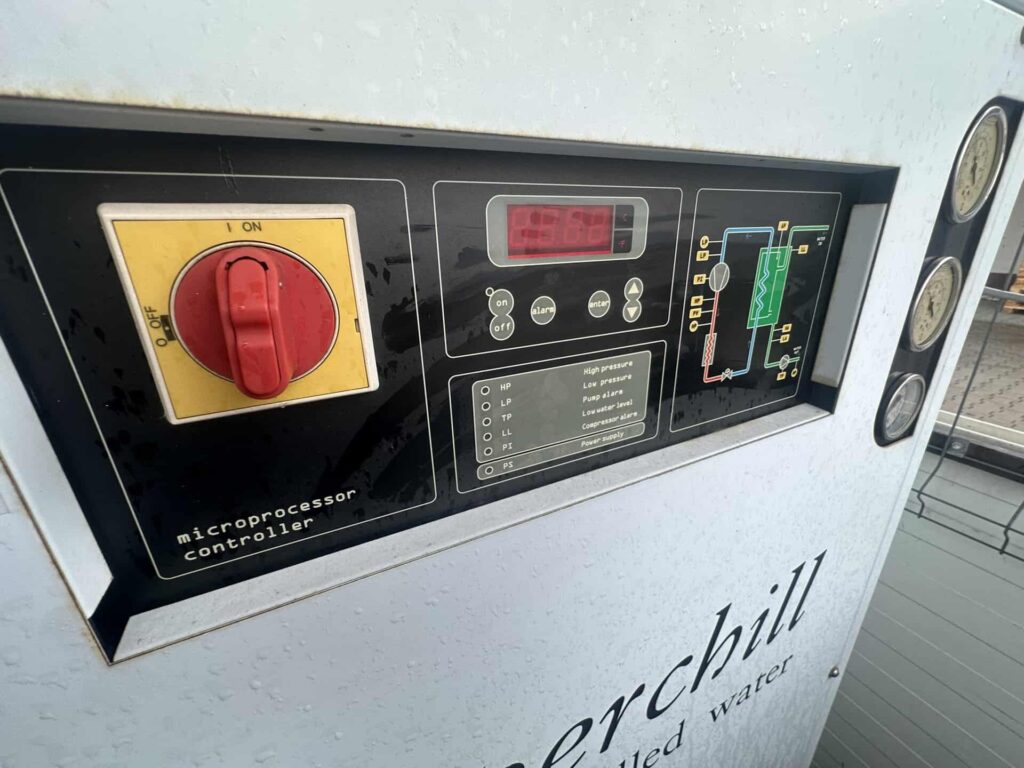
Process water, glycol and oil coolers
| Medium | Typical outlet temperature | Main risks |
|---|---|---|
| Process water (lasers, moulds) | 15 to 25 °C, stability often within 0.5 to 1 K | Scale, algae, corrosion, condensation on the machine when set too low |
| Water and glycol mixture | -10 to +10 °C | Diluted glycol, freezing in the evaporator, foaming |
| Hydraulic and spindle oil | Tracking room or machine temperature, or fixed 25 to 45 °C | Fouled heat exchanger, refrigerant leak into oil, worn oil pump |
For oil units, see our dedicated page on oil cooler repair, which covers immersion and circulation designs in more detail.
Diagnostics with measurements
We measure the cooler as a refrigeration unit and as a hydraulic unit at the same time. That is the only way to separate a lack of cooling capacity from a lack of flow.
- Inlet and outlet temperature of the medium and the flow, to calculate the actual heat load the machine is putting into the cooler.
- Evaporating and condensing pressures, superheat and subcooling.
- Pump discharge pressure compared with the pump curve.
- Compressor, pump and fan currents.
- Glycol concentration with a refractometer and water quality: conductivity, pH, visible contamination.
- Function of the hot gas bypass or capacity control at low load.
- Calibration of the temperature sensor that the controller uses.
For water, heat load in kW is roughly flow in m3/h multiplied by the temperature difference in K and by 1.16. A cooler rated at 10 kW that shows 2 m3/h and 3 K is only removing about 7 kW. If the machine needs more, the problem is in the cooler; if not, the alarm comes from somewhere else.
Common faults
Temperature drifting upwards in summer
Air-cooled coolers are usually rated at 32 to 35 °C ambient. Placed in a hot hall next to the machine, they draw air at 38 to 40 °C and lose capacity, while their condenser collects dust and oil mist. Cleaning, ducting the warm air out or moving the unit often solves the problem without a repair.
Flow alarm
Blocked strainer, air in the circuit after a machine change, a worn pump or a flow switch set at the limit. In circuits with quick couplings, a half-open coupling is a frequent and overlooked cause.
Low temperature trip or frozen evaporator
Glycol concentration too low, setpoint too close to the freezing point, or a stuck hot gas bypass valve at low load. A plate heat exchanger that freezes can crack and mix refrigerant with water, which turns a small repair into a large one.
Unstable temperature
Oversized cooler on a small load, controller parameters set for a different application, or a tank too small for the compressor minimum run time.
Workshop repairs
Compact coolers can be brought to our workshop in Wałsnów. There we pressure test the circuit with nitrogen, find leaks, replace compressors, pumps, plate heat exchangers and controllers, recharge by weight and run the unit on a test load before it goes back. A workshop repair is often faster than waiting for a team slot on site and lets us test the unit at full load. Pumps from coolers are regenerated as described on our pump repair page.
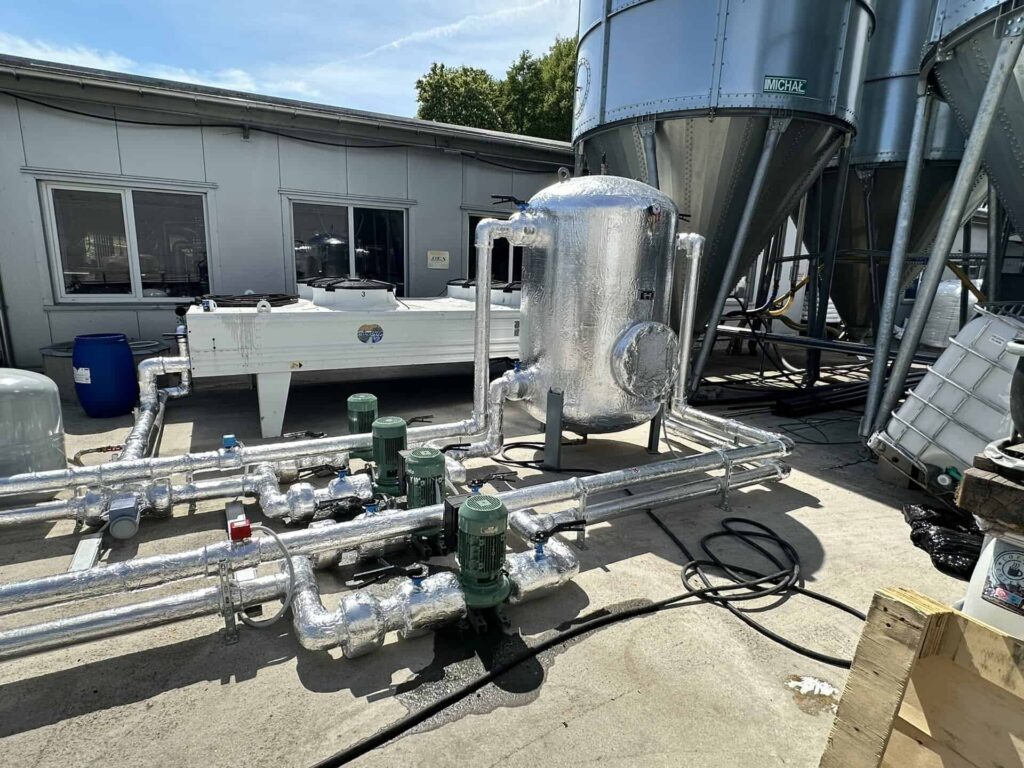
When several machines each have their own cooler, it can be worth replacing them with one central system with buffer tank and redundancy. We describe this approach on the process cooling page.
Questions from maintenance teams
Which glycol concentration should a cooler have?
The freezing point of the mixture should be at least 5 K below the lowest evaporating temperature, not only below the setpoint. For a setpoint of 5 °C we usually recommend about 25 to 30 percent ethylene glycol by volume, verified with a refractometer.
Can we use tap water in a laser cooler?
Only if the manufacturer of the laser allows it. Many sources require demineralised water with conductivity limits and inhibitors. Tap water leads to scale in the evaporator and in the laser itself.
Is a repair worth it on a ten-year-old cooler?
Often yes, if the compressor and the heat exchanger are sound. After diagnosis we give the repair cost next to the price of a new unit so the decision is easy.
Do you service coolers built into machines?
Yes. We coordinate with the machine operator, since the interface signals and alarms must be checked together with the machine control.
Cooler alarm stopping your machine?
Send the cooler nameplate and the alarm text, and we will tell you whether a site visit or a workshop repair is the faster route.